




There are moments in life when pain does not arrive alone.
It brings insult with it.
It brings injustice.
It brings misunderstanding.
It brings that heavy feeling where you ask yourself, “Why me?”
You try to stay kind, but people mistake your kindness for weakness.
You stay silent, but people think you have no answer.
You keep smiling, but inside, something is breaking again and again.
And yet, in the middle of all this, some people still choose faith.
They do not become bitter.
They do not become cruel.
They do not return hatred with hatred.
They carry their pain with dignity. They keep Krishna in their heart. They wipe their tears, smile at the world, and continue to do the right thing.
Such people are not weak. They are deeply strong.
Because real strength is not always loud. Sometimes, real strength is sitting alone with a broken heart and still saying, “Krishna, I trust You.”
Pain Is Not Always Punishment
Many people believe that suffering means they have done something wrong. They think pain is a punishment. They wonder if Krishna has forgotten them. They look at others who insult, cheat, manipulate, or hurt people and still seem happy. Then they look at their own life and feel confused.
“Why am I suffering when I am trying to be good?”
This question has lived in many hearts.
But the Bhagavad Gita gives us a deeper way to look at suffering. Pain is not always punishment. Sometimes, pain is purification. Sometimes, it removes our ego. Sometimes, it burns our attachments. Sometimes, it shows us who is real and who was only standing near us because life was convenient.
Pain teaches us what comfort never can.
Comfort can make us proud. Pain can make us humble.
Comfort can make us careless. Pain can make us aware.
Comfort can make us attached to the world. Pain can push us closer to Krishna.
That does not mean pain is easy. It is not. Anyone who says pain is beautiful has probably forgotten how heavy it feels when it sits inside the chest. Pain can make mornings feel difficult. It can make nights feel longer. It can make simple words hurt. It can make silence louder than noise.
But when a person carries pain and still refuses to lose faith, something sacred happens inside them. Their heart becomes softer, not harder. Their devotion becomes deeper, not weaker. Their relationship with Krishna becomes personal, not just religious.
Krishna Is Closest When the World Feels Farthest
There are times when the world does not understand your struggle. People may judge you from the outside without knowing the battles you are fighting within. Some may insult you. Some may use your goodness. Some may walk away when you need them the most.
That is when loneliness begins to speak.
But the devotee slowly learns that being unseen by the world does not mean being unseen by Krishna.
Krishna does not need public proof of your pain. He does not need others to validate your tears. He knows what you swallowed when you wanted to speak. He knows how many times you chose silence instead of anger. He knows how many nights you cried but still woke up and did your duty. He knows the moments when your heart wanted revenge, but your soul chose forgiveness.
Nothing is lost in front of Krishna.
Not one prayer.
Not one tear.
Not one act of kindness.
Not one moment of patience.
Sometimes we want immediate justice. That is human. When someone hurts us unfairly, we want the universe to respond quickly. We want wrong people to understand what they did. We want our pain to be acknowledged. We want someone to say, “You did not deserve this.”
But Krishna works beyond our impatience. His timing is not always visible, but it is never careless.
The Gita reminds us that a person who remains steady in sorrow, who does not lose themselves in happiness, and who is free from attachment, fear, and anger is a person of steady wisdom. This teaching is not asking us to become emotionless. It is asking us to become anchored.
A storm may shake the boat, but the anchor holds it in place.
For a devotee, that anchor is Krishna.
Your Silence Is Not Weakness
In today’s world, people often think strength means reacting quickly. If someone insults you, reply louder. If someone hurts you, hurt them back. If someone plays games, play a bigger game. This has become the normal advice.
But Krishna’s path is different.
Silence does not always mean defeat. Sometimes, silence means you have chosen peace over drama. Sometimes, silence means you trust Krishna more than your own anger. Sometimes, silence means you know the truth does not become weak just because lies are louder.
Forgiveness, is one of the most difficult forms of strength. It does not mean you approve of what happened. It does not mean you allow people to keep hurting you. It does not mean you become a doormat for someone else’s ego.
Forgiveness means you refuse to let someone else’s darkness live permanently inside your heart.
You may create distance. You may protect yourself. You may stop giving access to people who misuse your goodness. That is wisdom. But you do not have to poison your soul with hatred.
Hatred feels powerful for a while, but it quietly destroys the person carrying it.
Forgiveness feels difficult at first, but slowly it frees you.
Krishna does not ask you to be foolish. He asks you to be pure. There is a big difference.
A pure heart can still have boundaries. A kind person can still walk away. A forgiving soul can still say, “This is not acceptable.”
A Smile Through Pain Is Tapasya
There is a kind of smile that the world does not understand. It is not a fake smile. It is not a social media smile. It is not pretending that everything is fine.
It is the smile of someone who has cried enough but has not given up.
It is the smile of someone who has been tested but not defeated.
It is the smile of someone who knows Krishna is still holding the story, even when the current chapter feels painful.
This is Tapasya. Endurance. Inner discipline. The ability to continue walking the path of dharma even when the road is rough.
Tapasya is not only sitting in meditation in the mountains. Tapasya is also staying honest when dishonesty looks profitable. Tapasya is staying kind when cruelty looks easier. Tapasya is doing your duty when your heart feels tired. Tapasya is controlling your words when anger is begging to come out.
And perhaps the greatest Tapasya is keeping your heart soft in a world that keeps trying to harden it.
Anyone can become bitter after pain. That is easy. Pain gives plenty of reasons to become cold. But to suffer and still remain kind is rare. To be insulted and still not insult back is rare. To face injustice and still keep faith is rare.
Such a heart becomes dear to Krishna.
Faith Is Not Blindness
Some people misunderstand faith. They think faith means ignoring reality. They think devotion means accepting everything without question. They think a devotee should never feel hurt, angry, tired, or confused.
That is not true.
Faith does not mean you never cry. Faith means you cry at Krishna’s feet.
Faith does not mean you never feel fear. Faith means you hold Krishna’s name while walking through fear.
Faith does not mean you understand everything. Faith means you trust that Krishna understands what you cannot.
Shraddha, or devotion, is not blindness. It is a deeper kind of seeing. It allows you to look beyond the immediate pain and believe that your life is not meaningless. It reminds you that every experience, even the bitter ones, can become part of your spiritual growth.
This does not make suffering pleasant. But it gives suffering a direction.
Without faith, pain can make a person collapse.
With faith, pain can become a path.
The same fire that burns wood also purifies gold. The difference is not in the fire. The difference is in what is placed inside it.
A devotee’s heart, when placed in the fire of suffering, becomes more refined.
Choosing Kindness When You Have Every Reason Not To
One of the most beautiful qualities of a true devotee is kindness. Not soft words only. Not polite behaviour only. Real kindness. The kind that survives pain.
It is easy to be kind when people are kind to us. It is easy to be loving when life is going well. It is easy to speak about forgiveness when nobody has deeply hurt us.
The real test begins when someone insults us. When someone betrays our trust. When someone treats us unfairly. When we are blamed for things we did not do. When our goodness is taken for granted.
That is when the heart stands at a crossroads.
One road says, “Become like them.”
The other road says, “Remain with Krishna.”
The first road may feel satisfying for a moment. The second road builds your soul.
Choosing kindness does not mean you become passive. It means you do not let another person decide the quality of your heart. Their behaviour is their karma. Your response is yours.
This is where spiritual maturity begins.
When people hurt you, your first instinct may be revenge. That is natural. But when you pause, breathe, remember Krishna, and choose dignity instead, you rise above the situation. You may still take action. You may still speak the truth. You may still protect yourself. But you do it without becoming hateful.
That is not weakness.
That is mastery over the self.
Krishna Never Ignores a Devoted Heart
Sometimes, life feels unfair because results are not immediate. Good people suffer. Wrong people seem to win. Truth is delayed. Lies appear successful. This can shake anyone.
But Krishna’s justice is not limited to what we see in one moment.
The Gita teaches that we have control over our actions, but not always over the immediate results. This is one of the hardest truths to accept. We want quick outcomes. We want visible answers. We want pain to end when we decide it should end.
But devotion teaches patience.
Krishna sees the full picture when we only see one page. He knows why certain doors closed. He knows why certain people left. He knows why certain delays protected us. He knows why certain pain became necessary for our growth.
A devoted heart is never ignored.
Your tears may be hidden from the world, but they are not hidden from Krishna. Your prayers may be whispered, but they are heard. Your pain may be private, but it is not meaningless.
There is a beautiful comfort in knowing that Krishna does not judge us by our outer success. He looks at the heart. He sees whether we remained sincere. He sees whether we chose dharma when adharma looked easier. He sees whether we carried pain without destroying others.
And when Krishna sees a heart that remains kind even after being hurt, He protects it in ways the world may never understand.
The Real Victory Is Inside
The world celebrates visible victories. Money. Status. Power. Recognition. Winning arguments. Proving others wrong. Making people regret.
But Krishna’s path often points to a quieter victory.
The victory of not losing yourself.
The victory of not becoming cruel.
The victory of not allowing pain to steal your devotion.
The victory of keeping your heart clean when life gives you reasons to pollute it.
That is a victory the world may not clap for, but Krishna knows its value.
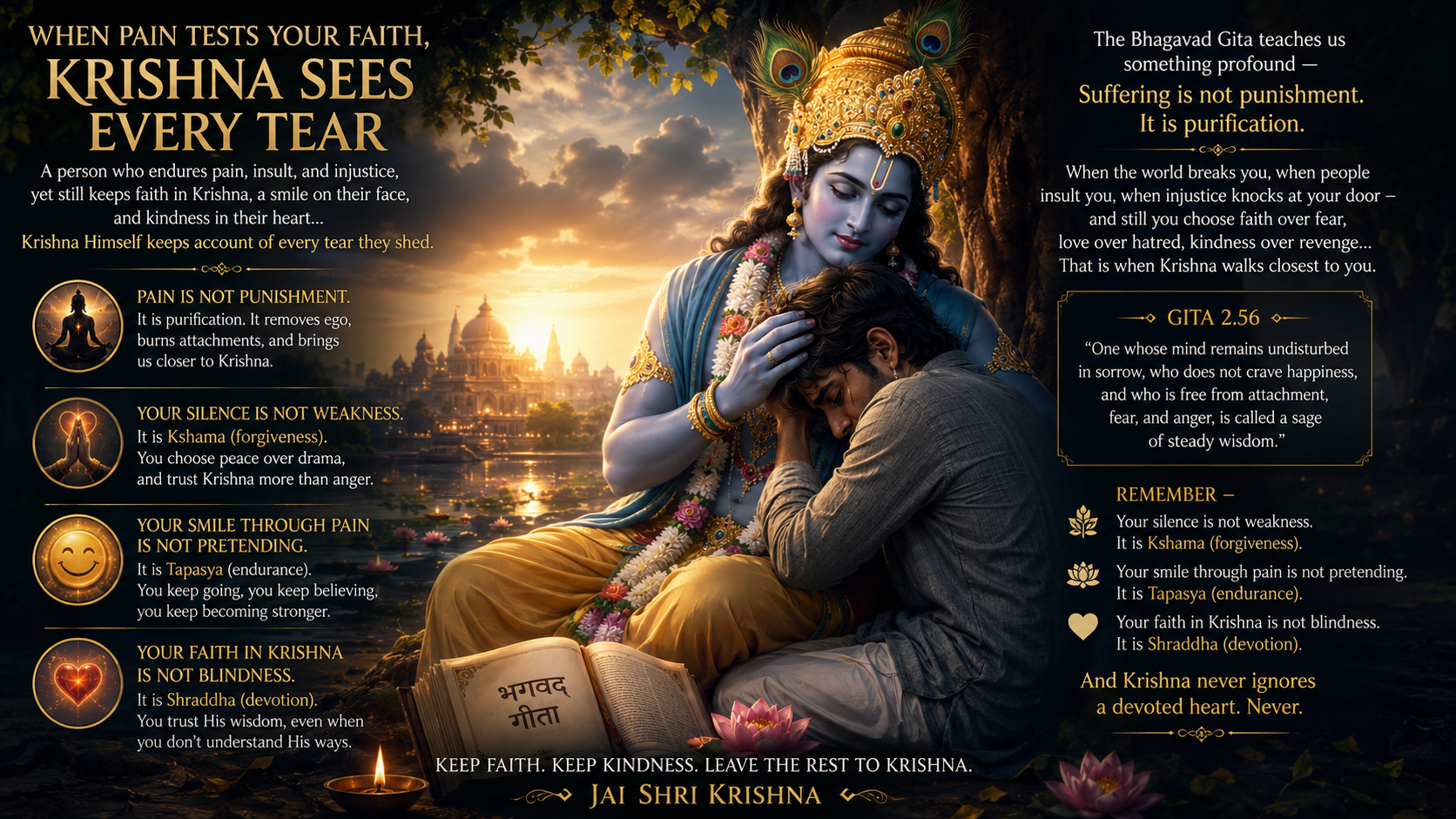
A person who endures pain, insult, and injustice, yet still keeps faith in Krishna, a smile on their face, and kindness in their heart, is living a powerful form of devotion. Their life itself becomes prayer. Their patience becomes worship. Their forgiveness becomes strength. Their tears become offerings.
So when you feel tired, remember this.
Your silence is not weakness. It may be Kshama.
Your smile through pain is not pretending. It may be Tapasya.
Your faith in Krishna is not blindness. It is Shraddha.
And Krishna never ignores a devoted heart.
Never.
Jai Shri Krishna.