





Some people spend half their life waiting to be recognised.
They wait for the right manager to notice them. They wait for the perfect opportunity to arrive. They wait for confidence to magically appear before they apply for the role, start the business, write the book, speak in the meeting, or make the change they already know they need to make.
The uncomfortable truth is that life does not usually hand value to anyone like a certificate at a ceremony. Most of the time, value is built slowly, through choices that look ordinary from the outside but change everything over time.
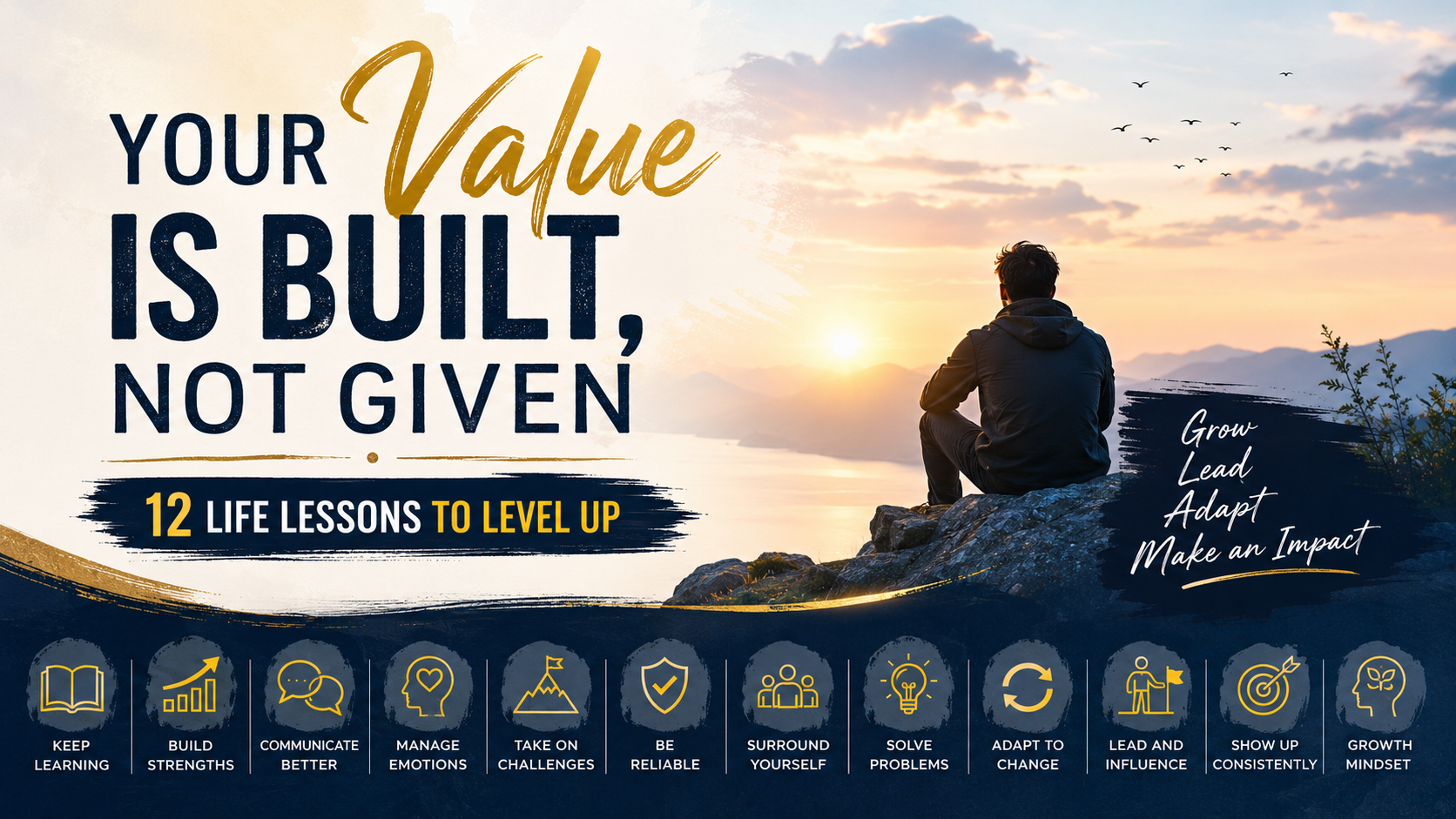
It is built when you keep learning even after work has drained your brain like an old phone battery. It is built when you do what you said you would do, even when nobody is clapping. It is built when you solve problems instead of becoming another person pointing at the problem with dramatic disappointment. It is built when you manage your emotions, improve your communication, choose better people, take harder challenges, and show up with some consistency instead of waiting for motivation to send a formal invitation.
And no, this does not mean life becomes easy. It means you become stronger, sharper, and more useful in the middle of it.
The world remembers people who create value. Not always immediately. Sometimes not loudly. But eventually, people notice the person who learns fast, communicates clearly, handles pressure, brings solutions, keeps promises, adapts to change, and makes life easier for everyone around them.
That kind of value cannot be faked for long. It has to be built.
Invest in continuous learning
The first way to build value is to stay teachable. That sounds simple, but it is surprisingly rare. Many people stop learning once they get comfortable in a job, a relationship, a routine, or a title. They start repeating what worked five years ago and then feel confused when life moves on without asking for their permission.
Continuous learning does not mean you need to spend every evening buried under online courses, surrounded by notebooks, looking like the main character in a productivity advertisement. It simply means you keep your mind open. You read. You ask questions. You listen to people who know more than you. You learn from people younger than you too, because sometimes the new world does not come through seniority, it comes through fresh eyes.
A person who keeps learning has more options. That matters. When one door closes, they are not left staring at it like it personally betrayed them. They can move. They can adjust. They can apply their thinking somewhere else. In work, this could mean learning a new technology, a better way to present ideas, a new leadership skill, or a deeper understanding of the business. In personal life, it could mean learning how to handle conflict, manage money, build discipline, or take care of your health before your body starts sending strongly worded complaints.
Learning keeps you relevant. It also keeps you humble. And humility, when mixed with action, is one of the most underrated growth tools in the world.
Sharpen your strengths
There is a strange pressure today to become good at everything. People want to be strategic, creative, technical, emotional, disciplined, charismatic, analytical, visionary, practical, calm, bold, and somehow also available for every meeting. Lovely idea. Completely exhausting.
You do not build real value by trying to become excellent at every possible thing. You build it by understanding your natural strengths and then sharpening them until people associate you with a clear type of excellence.
Maybe you are good at explaining complex topics in simple language. Maybe you are the person who stays calm when everyone else turns a small issue into a courtroom drama. Maybe you are good at connecting people, spotting patterns, building systems, writing clearly, selling ideas, fixing broken processes, or seeing risks before they become expensive disasters.
The point is not to ignore your weaknesses completely. Some weaknesses must be improved because they block progress. But your biggest growth often comes from taking what you are already good at and making it noticeably better.
Think about the people you respect. You probably remember them for something specific. Someone is brilliant at execution. Someone is great with people. Someone has rare judgement. Someone can walk into chaos and create structure. That is how signature value works. It gives people a reason to trust you, recommend you, and remember you.
Improve your communication skills
Skill without communication can remain invisible for years. You may know the answer, have the experience, understand the problem, and see the better path, but if you cannot explain it clearly, people may walk past your value without realising what they missed.
Good communication is not about sounding clever. In fact, many people hide weak thinking behind complicated language and then call it expertise. Strong communication makes things easier to understand. It helps people know what you mean, what you need, what you recommend, and why it matters.
At work, communication is often the difference between being seen as capable and being seen as confusing. The person who can explain a problem simply, write a clear email, speak confidently in a meeting, listen without interrupting, and turn disagreement into progress becomes valuable very quickly. Not because they talk the most, but because they reduce friction.
In personal life, communication matters just as much. A poorly said sentence can create a fight that lasts for days. A thoughtful sentence can repair trust. Listening properly can save a relationship from becoming a collection of assumptions. Saying what you mean without attacking someone is a life skill, not a luxury.
If you want to build value, learn to speak clearly, write simply, listen with attention, and express your ideas without making people feel small. Good communication opens doors that talent alone often cannot.
Develop emotional intelligence
Life is full of people, and people are complicated. That includes us, by the way. We all like to believe we are rational, balanced, and mature until someone ignores our message, questions our work, cuts us off in traffic, or gives feedback with the emotional warmth of a brick wall.
Emotional intelligence is the ability to understand what is happening inside you without letting every feeling take control of the steering wheel. It is noticing when you are angry, hurt, insecure, defensive, jealous, or tired, and still choosing a response that will not create a bigger mess than the original problem.
This does not mean pretending you do not feel anything. That is not maturity. That is emotional storage, and storage eventually leaks. Emotional intelligence means you can feel something strongly and still behave with self-respect.
In leadership, emotional intelligence is priceless. People do not enjoy following someone who explodes under pressure, takes everything personally, or makes the whole team nervous before every conversation. In relationships, it helps you respond instead of react. In friendships, it helps you understand that not every delayed reply is rejection and not every disagreement is disrespect.
The more emotionally intelligent you become, the less life can drag you into unnecessary battles. You learn which situations need your energy and which ones only want your reaction.
Take on challenges that stretch you
Comfort has a nice voice. It tells you to stay where things are familiar. It tells you that you can try later. It tells you that you are not ready yet. Sometimes it even sounds logical, which makes it more dangerous.
The problem is that comfort can protect you from embarrassment while also protecting you from growth. If you only do what you already know, you will keep getting versions of what you already have. To become more valuable, you need challenges that stretch your current ability.
This could mean taking a bigger role, learning a difficult skill, speaking in front of people, leading a project, starting again after failure, or having a conversation you have avoided for too long. None of these things feel comfortable at the beginning. That is the point.
A person who goes to the gym does not grow stronger by lifting air. Strength comes from resistance. Character works in a similar way. Responsibility, pressure, uncertainty, and difficulty reveal parts of you that comfort never touches.
Of course, you do not need to say yes to every challenge. Some challenges are growth opportunities. Others are just badly disguised chaos. Wisdom is knowing the difference. But when a challenge aligns with your growth, values, or future direction, do not reject it only because it scares you. Fear is not always a warning to stop. Sometimes it is proof that the next version of you is being invited to show up.
Build a strong work ethic
There is nothing glamorous about showing up on time, keeping promises, finishing what you started, and doing the boring parts properly. That is probably why so many people underestimate it. But reliability is powerful because it is becoming rare.
A strong work ethic does not mean destroying your health, answering messages at midnight, or treating burnout like a badge of honour. That is not work ethic. That is poor boundary management wearing a business suit.
Real work ethic means you respect your commitments. You do what you said you would do. You prepare properly. You do not need constant supervision like a houseplant with deadlines. You take ownership. You stay consistent even when your mood is not cooperating.
In many workplaces, the person who is reliable becomes more valuable than the person who is only brilliant on selected days. Talent can impress people once, but reliability builds trust over time. People remember who delivered when it mattered. They remember who followed through. They remember who did not disappear when the work became difficult.
The same is true outside work. Friendships need reliability. Families need reliability. Personal goals need reliability. You cannot build a serious life on occasional effort and permanent excuses.
Surround yourself with high-value people
Your environment shapes your standards. Spend enough time around people who complain about everything, avoid responsibility, mock ambition, and treat discipline like a personality defect, and sooner or later their thinking will start sounding normal.
High-value people are not perfect. They do not walk around glowing with wisdom while drinking herbal tea and making flawless decisions. They are simply people who raise your standards. They inspire you, challenge you, tell you the truth, and make growth feel normal.
These people may be friends, mentors, colleagues, family members, or even people you learn from at a distance through books, podcasts, talks, or meaningful conversations. What matters is that their presence makes you think bigger, act better, and stop negotiating with your excuses.
You do not need to abandon everyone who is not on the same path as you. Life is not a motivational movie where every personal upgrade requires dramatic background music and cutting off half your contact list. But you do need to become honest about influence. Some people drain your energy. Some people sharpen it. Some conversations leave you inspired. Others leave you smaller.
A better life often begins with better conversations. Choose them carefully.
Learn to solve problems creatively
People who solve problems become valuable almost everywhere. Workplaces need them. Families need them. Communities need them. Even friendships need them, because nobody wants to spend years around someone who treats every inconvenience like a national emergency.
Creative problem-solving is not about having genius ideas all the time. It is about refusing to stop at the first obstacle. It is asking, “What else can we try?” It is looking for options when everyone else is busy explaining why nothing will work.
There is a big difference between someone who complains and someone who contributes. A complainer adds weight to the room. A problem-solver brings oxygen. They may not always have the perfect answer, but they help move the conversation forward.
In business, problem-solvers save time, money, and stress. In leadership, they create confidence. In personal life, they reduce drama. Instead of saying, “This is impossible,” they ask, “What is the smallest next step?” Instead of blaming everyone, they look for leverage. Instead of waiting for ideal conditions, they work with what is available.
This mindset makes you valuable because problems are not going anywhere. Life will keep producing them with impressive creativity. The question is whether you become another voice of panic or someone who helps find a way through.
Stay adaptable and open to change
Change is not slowing down for anyone. Technology changes, industries change, people change, expectations change, and the skills that once made you stand out can become basic requirements before you have even finished enjoying your confidence.
Adaptability is not about chasing every trend like a confused squirrel. It is about staying flexible enough to respond when reality changes. You can keep your values while changing your methods. You can respect your experience while learning something new. You can be confident without becoming stubborn.
Some people struggle with change because they see it as an insult to what they already know. But learning a new way does not mean the old way was useless. It means the situation has moved, and now you must move with it.
The most adaptable people are not always the loudest innovators. Sometimes they are simply the ones who accept feedback without turning it into a personal tragedy. They test new tools. They update their thinking. They ask better questions. They adjust quickly instead of spending months arguing with reality.
In a changing world, adaptability is not optional. It is one of the strongest forms of survival.
Develop a growth mindset
A fixed mindset says, “I am not good at this.” A growth mindset says, “I am not good at this yet.” That one word changes the whole conversation.
When you believe your skills can improve through effort, practice, feedback, and better strategy, failure becomes less frightening. It still hurts, of course. Nobody enjoys failing. People who say they love failure are usually speaking from a stage with good lighting. But with a growth mindset, failure becomes information rather than identity.
You can look at a poor result and ask what it taught you. You can take feedback without deciding your entire life is ruined. You can start badly and keep going long enough to become decent, then good, then impressive.
A growth mindset is especially important in adulthood because many adults avoid being beginners. They do not want to look inexperienced, so they stay trapped in familiar limitations. But every meaningful skill has an awkward beginning. The first presentation may be rough. The first article may feel clumsy. The first leadership role may expose gaps. The first attempt at a new habit may last three days and a half-hearted Monday.
That does not mean you cannot grow. It means you are human. Keep going anyway.
Increase your ability to lead and influence
Leadership is not just a title printed under your name. Some people have titles and still create confusion everywhere they go. Others have no formal authority, yet people trust them because their actions carry weight.
Real leadership begins with responsibility. It is the willingness to set the standard, make decisions, encourage others, handle difficult conversations, and take ownership when things do not go as planned. It is not about acting important. It is about being useful when it matters.
Influence grows when people see consistency between what you say and what you do. If you talk about discipline but never follow through, people notice. If you speak about respect but treat people badly under pressure, people notice that too. Leadership is always being measured, even when nobody says it out loud.
Good leaders also know how to bring out the best in others. They do not need to dominate every conversation. They ask questions. They listen. They give credit. They challenge people without humiliating them. They make people feel capable, not small.
The more you can lead yourself, the more naturally you can influence others. Self-leadership comes first. Without it, leadership becomes performance.
Show up as your best self consistently
One good day feels nice, but it does not change your life. A good week helps, but even that is only a start. What changes your life is the habit of returning to your standards again and again, especially after you fall off track.
Consistency does not mean perfection. This is important, because many people quit the moment they miss one workout, waste one evening, lose focus for a few days, or make one poor decision. They treat a small slip like a complete collapse. That mindset destroys progress.
Showing up as your best self means you come back. You return to your health. You return to your goals. You return to your values. You return to the version of yourself you are trying to build, even if yesterday did not go well.
Confidence grows from this kind of consistency. Not fake confidence. Not loud confidence. Real confidence. The kind that comes from knowing you can trust yourself. When you repeatedly keep promises to yourself, your self-respect becomes stronger. You stop needing constant approval because your own behaviour gives you evidence.
That is how value is built. Not through one dramatic transformation, but through repeated choices that slowly change your identity.
Final thoughts
Your value is not something the world gives you because you waited patiently. It is something you build through learning, discipline, communication, emotional intelligence, courage, adaptability, problem-solving, leadership, and consistency.
Some of these lessons sound simple, and maybe they are. But simple does not mean easy. Most people know what would improve their life. Fewer people practise it long enough for the results to appear.
The good news is that you do not need to rebuild your entire life in one heroic weekend. You can start with one area. Learn something useful. Have one better conversation. Keep one promise. Solve one problem. Take one challenge. Improve one habit. Then repeat.
Over time, those small actions stop looking small. They become your reputation. They become your confidence. They become your value.
And the best part is this: once you build real value within yourself, you no longer need to beg the world to notice you. You become the kind of person whose growth, reliability, and impact are difficult to ignore.