





Success is a strange teacher.
When things go well, we rarely stop to examine the exact reasons behind the outcome. The moment we experience a win, our mind automatically begins forming patterns. It assumes that the action we took was the cause of the result we achieved.
Sometimes that assumption is correct.
But sometimes it is dangerously wrong.
Many failures in life, business, and leadership do not come from ignorance or lack of effort. They come from repeating a strategy that once worked without understanding why it worked in the first place.
There is a simple story that captures this idea perfectly.
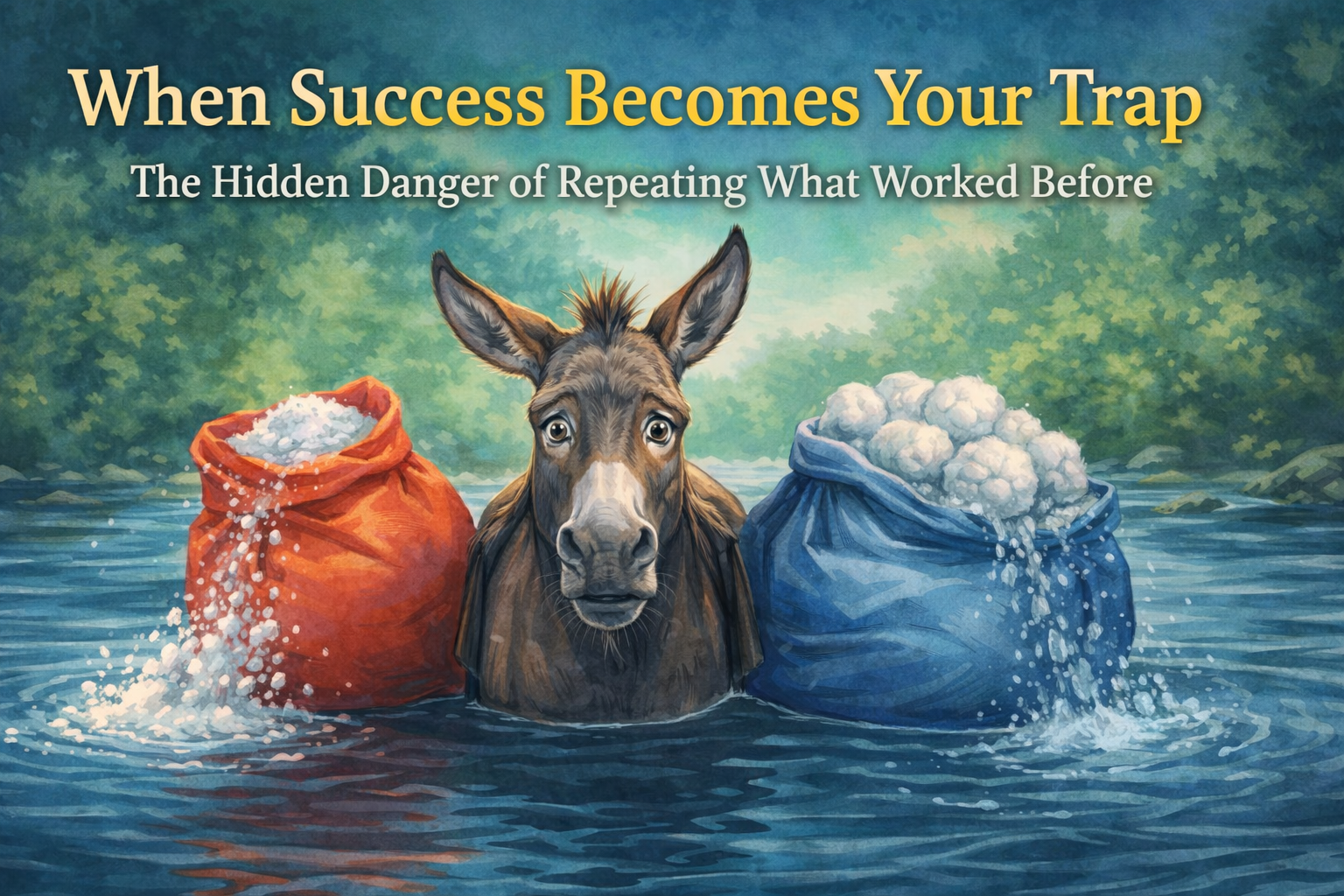
A story about a donkey, a river, and two very different loads.
The Donkey Who Thought It Had Discovered a Trick
A donkey was carrying two heavy sacks of salt across a river. The path required crossing the water each day as part of its routine work.
One afternoon, while stepping through the shallow current, the donkey slipped and fell into the river.
For a moment it struggled to regain balance.
But when it finally stood up, something surprising happened.
The load felt lighter.
The sacks of salt had partially dissolved in the water. What had once been heavy suddenly felt easier to carry.
From the donkey’s perspective, this seemed like a brilliant discovery.
It believed it had found a clever shortcut.
Instead of understanding what truly happened, it formed a simple conclusion.
Falling into the river reduces the weight.
The Birth of a False Strategy
The next day, the donkey had to carry another load across the same river.
But this time the sacks were filled with cotton.
The donkey remembered its previous “success.” The memory of the lighter load had already turned into a strategy.
As soon as it reached the middle of the river, it intentionally jumped into the water.
The donkey expected the same result.
But something very different happened.
Cotton does not dissolve like salt.
It absorbs water.
Within seconds the cotton sacks became heavier than before. The weight multiplied, the load doubled, and the donkey struggled under the burden.
Instead of making the journey easier, the same action made the situation far worse.
What once looked like a clever trick became a costly mistake.
The Problem Was Never the River
At first glance, it might appear that the donkey made a simple error. But the deeper issue is far more interesting.
The donkey misunderstood the source of its success.
The lighter load had nothing to do with falling into the river. The real reason was the nature of salt itself. When salt touches water, it dissolves.
The donkey assumed the outcome came from its action.
In reality, the outcome came from the material it was carrying.
This distinction is small, yet incredibly important.
Many people make the same mistake in real life.
They repeat actions that once worked without recognizing the context that made those actions successful.
Why One-Time Success Can Be Misleading
Human beings are natural pattern seekers.
When something works once, we quickly build a story around it. We assume we have discovered a reliable method.
In business, someone might launch a product that suddenly becomes successful. Instead of examining market conditions, timing, and external factors, they assume their strategy was perfect.
In careers, someone might receive a promotion after working late hours for several months. They conclude that long hours automatically lead to advancement.
In investing, someone might make money on a risky trade and believe they have discovered a winning system.
The danger lies in confusing luck, timing, or circumstance with repeatable skill.
The donkey did not understand salt.
So it misunderstood success.
Rule One: Learn the Difference Between Skill and Luck
One of the most important lessons in decision making is identifying the real cause behind a successful outcome.
Sometimes success happens because of skill.
Sometimes it happens because the environment favored you.
And sometimes it happens purely because of chance.
Without analyzing the difference, people begin repeating behaviors that are not actually responsible for their victories.
This is why professional investors constantly review their decisions. They ask questions like:
Did this strategy work because it was sound?
Or did it work because the market happened to move in our favor?
Understanding this difference protects you from the illusion of competence.
The donkey believed its action created the result.
But the real reason had nothing to do with the action itself.
Rule Two: Avoid Copy-Paste Thinking
Strategies rarely survive when blindly copied from one situation to another.
What worked in one environment may completely fail in another.
A business strategy that succeeds in a booming market may collapse during an economic downturn. A leadership style that motivates one team might frustrate another.
The donkey assumed the river was the solution.
It did not check whether the load was salt or cotton.
The environment stayed the same.
The material changed.
And that single variable changed everything.
The same mistake appears everywhere in the real world. People try to replicate someone else’s success without understanding the hidden variables that made it possible.
True strategic thinking requires asking deeper questions before repeating a method.
Rule Three: Experience Must Be Updated
Experience is often considered one of the greatest advantages in life.
But experience can also become dangerous when it stops evolving.
Many people rely on lessons learned years ago without updating them to reflect new conditions. Industries change. Technology advances. Markets evolve.
Strategies that once worked perfectly may become outdated.
The donkey trusted its previous experience without questioning whether the situation had changed.
And that blind trust created a bigger problem.
Experience becomes valuable only when it is regularly reviewed, refined, and updated.
Otherwise it becomes a rigid belief system that ignores new realities.
The Trap of Permanent Formulas
One of the biggest mistakes people make is turning temporary success into permanent rules.
The world does not operate on fixed formulas.
Conditions change constantly.
Markets shift.
Technology evolves.
Human behavior adapts.
Strategies that once created success may become irrelevant or even harmful in a different context.
The donkey believed it had discovered a universal trick.
But it had only experienced a temporary coincidence.
The Question to Ask Before Every Opportunity
Before repeating a strategy that once worked, it is worth asking a simple but powerful question.
Why did this work the first time?
Was it because of my decision?
Was it because of timing?
Was it because of the environment?
Or was it because of factors I did not fully understand?
This kind of reflection transforms random experiences into genuine learning.
Without that reflection, people continue repeating behaviors that may eventually lead them into deeper problems.
Just like the donkey that believed falling into the river was a clever idea.
A Simple Lesson with a Powerful Message
The story of the donkey, the salt, and the cotton is simple.
Yet it captures one of the most important principles of intelligent thinking.
Success alone does not teach wisdom.
Understanding success does.
If you cannot explain why something worked, repeating it may be the fastest way to fail.
The next time an opportunity appears, pause before jumping into the river.
Take a closer look at what you are carrying.
Because sometimes you are holding salt that will lighten the load.
And sometimes you are carrying cotton that will pull you under.