


After losing my father, I found traces of his love in a yellow cardigan, an old photograph, and the ordinary things he had kept.
The last time my father called, I watched his name appear on my phone and waited for it to disappear.
I was sitting on the bedroom floor with a cardboard box between my knees. Inside were the things we had bought for the baby: two cotton blankets, a packet of tiny socks, and a book my husband had picked up because he liked the drawing of a bear on the cover.
For six weeks, I had been telling myself I would put the box away. That afternoon, I had finally taken it down from the wardrobe, only to find that I could not close it again.
My father called at four seventeen. He left no message.
Three days later, he died.
For a long time, those two facts lived beside each other in my mind as if one had caused the other. People told me that I could not have known, and of course I knew they were right. He had been well enough to argue with the mechanic about the price of a new tyre that morning. He had bought coriander from the market and left it in the kitchen sink, where it was still lying when my brother arrived.
None of that changed what I saw whenever I closed my eyes: my father’s name lighting up the screen, and my hand turning the phone face down.
My brother, Sameer, called me from our father’s house. I knew something had happened before he spoke because he said my name without the briskness he usually used when he wanted a favour.
“He’s gone,” he said.
I asked him to repeat it, though I had heard him clearly.
The journey home took four hours. My husband drove while I sat with my hands folded in my lap, looking at the road without taking any of it in. He tried to hold my hand at a traffic light, and I pulled away before I could stop myself. He said nothing. We had spent the previous two months learning that there were moments when comfort felt unbearable, even when it came from someone we loved.
At the house, Sameer opened the door and stepped aside. The hallway smelled of floor cleaner and the cardamom tea our father made every morning. A pair of his sandals sat near the wall, one slightly ahead of the other, as though he had just kicked them off.
I had expected death to make the house feel different. Instead, everything looked painfully ready for him to come back.
In the kitchen, his reading glasses rested beside a folded newspaper. There was a steel bowl on the counter with two apples and a soft pear he would have cut around rather than thrown away. I found myself wanting to move the pear into the fridge, then felt foolish for thinking about fruit when my brother was in the next room calling relatives.
That first evening passed in tasks. I found phone numbers. I answered questions about our father’s full name and date of birth. I looked for a clean shirt because Sameer could not bear to open the wardrobe. When someone asked whether our father had any particular wishes, I said I did not know.
There was so much I did not know.
Our father had never been easy to talk to about feelings. If I said I was tired, he asked whether I was eating properly. If I told him work was difficult, he suggested I speak to my manager. When I was young, I mistook this for a lack of interest. Later, I came to recognise that he was trying to solve problems because sitting with them frightened him.
Still, the past few months had been harder between us than anything that came before.
When I told him I was pregnant, he had smiled so widely that his face seemed younger. He began sending photographs of things he found in shops: a yellow knitted cardigan, a wooden toy train, a pram that was far too expensive. I told him it was early and asked him to slow down. He promised he would, then sent another photograph the following week.
After we lost the baby, I could not bear the thought of his excitement turning into pity. My husband offered to tell him, but I wanted the words to come from me. I phoned and said what had happened in a voice so flat that it hardly sounded like mine.
My father was silent for several seconds. Then he asked whether I had seen a doctor and whether I was resting.
“Yes,” I said to both questions.
“I can come,” he said.
“You don’t need to.”
“I know I don’t need to.”
I told him I would call the next day. I did not.
He tried again over the following weeks, sometimes by phone and sometimes with short messages that asked about the weather, a leaking tap, or a recipe he insisted my mother used to make differently. I answered when I could manage it. More often, I read his messages and put the phone away.
At the funeral, I stood beside Sameer and listened as people spoke about my father. A former colleague remembered that he had driven across town one night to help when her car broke down. A neighbour described how he brought her bins in after she hurt her back.
I knew these things sounded like him, yet I resented how easily everyone else seemed able to gather their memories into a complete person. Mine came in pieces that hurt to hold.
After the guests left, Sameer and I began sorting through the house. We agreed to take it slowly. By the second afternoon, we were arguing over a drawer of old bank statements neither of us wanted.
“You can leave those,” he said.
“I’m trying to help.”
“I know.”
The way he said it made me look up. Sameer was standing by the dining table with a stack of papers against his chest, and his eyes were red. He had spent two days making calls, arranging meals, finding documents, and asking me if I needed anything. I had not once asked him the same question.
“I’m sorry,” I said.
He put the papers down. “I kept thinking he’d call me to ask if I’d had lunch. It’s ridiculous, because I’m forty-two years old and he asked me every day.”
I pulled out a chair, and he sat across from me. For the first time since I had arrived, we talked about our father without trying to organise anything.
Sameer told me that our father had recently started going to the park before breakfast because a man there brought a dog he liked. I told Sameer about the toy train photograph. We laughed at how our father had zoomed in so far that most of the train was missing.
Then Sameer said, “He was worried about you.”
I looked down at the table.
“He asked if I’d spoken to you, but he didn’t want me to tell you he’d asked.”
“I know I should have called.”
“That isn’t why I’m telling you.”
I wanted to believe him, but guilt had become the easiest way to make sense of what had happened. It gave my thoughts somewhere familiar to go, even though it could not bring my father back.
That evening, I went into his bedroom to look for a photograph for the small table we had set up downstairs. His wardrobe held the shirts I knew, arranged by colour in a system he would have denied having. In the top drawer, beneath a bundle of receipts, I found a paper bag from a children’s shop.
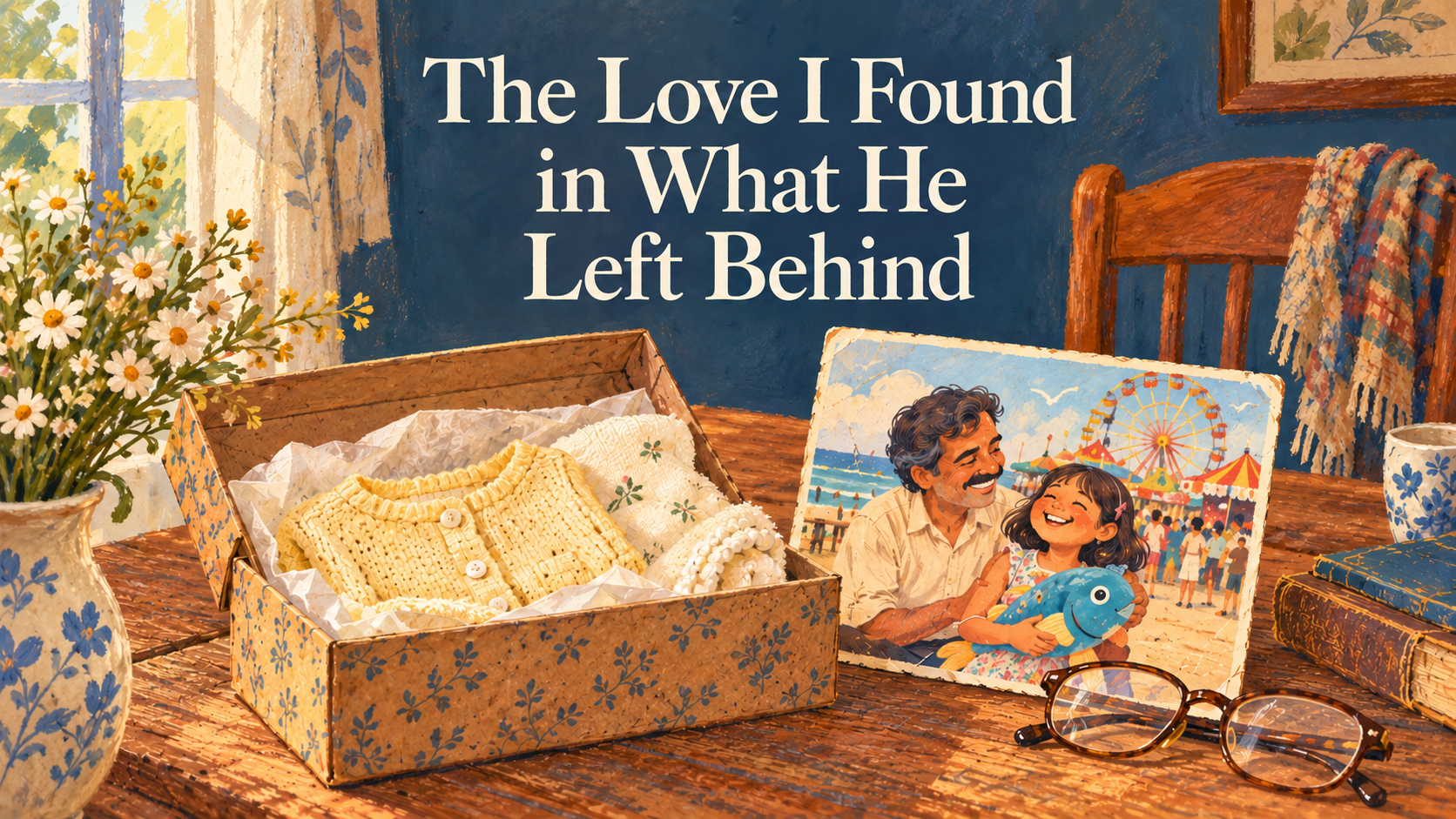
Inside was the yellow cardigan from his photograph.
I sat on the edge of the bed with it in my hands. He must have bought it before I told him we had lost the baby. I wondered whether he had kept it because he could not bring himself to return it, or because he thought giving it to me someday might be possible. I would never know, and that uncertainty felt more honest than any answer I could invent.
Under the cardigan was an envelope with my name on it. For one startling moment, I thought he had written me a letter. It held a photograph instead.
I was about eight years old, standing beside him at a seaside fair. I had a paper crown on my head and a large stuffed fish tucked under one arm. My father was looking at me rather than the camera, laughing at something I had said. On the back, in his uneven handwriting, he had written the place and the year.
I could remember that day. He had spent nearly all the money he brought trying to win the fish because I was certain it was the finest prize at the fair. On the drive home, I fell asleep holding it. When I woke, it was still in my arms, and my father was sitting in the parked car waiting rather than waking me.
I had forgotten that part for years.
I carried the photograph and the cardigan downstairs. Sameer was washing cups in the kitchen. When he saw what I had found, he dried his hands and came to sit beside me.
“He showed me that,” Sameer said, touching the edge of the photograph. “He found it a few weeks ago.”
“Did he say why he kept it in the drawer?”
“No. He just said you looked happy.”
I thought about the call I had missed. Until then, I had imagined it as one final chance to say everything we had left unsaid. Sitting there with Sameer, I realised my father probably would have asked whether the tap had been fixed, or told me about the dog in the park. I might have been too tired to talk for long. He might have heard that in my voice and said he would call another day.
I still wished I had answered. I always would. But I knew him well enough to understand that one missed call did not contain the whole of our life together.
When I returned home, the box was where I had left it, beside the wardrobe. My husband had moved around it for days without asking what I wanted to do. That night, I showed him the cardigan and the photograph, and we sat on the floor together.
I told him about the fair, the stuffed fish, and my father waiting in the car while I slept. Then I told him how much I had wanted our child to know him. My husband took the cardigan from my hands and held it for a while before folding it carefully.
We put it in the box with the blankets and the socks. I added the photograph, then changed my mind and took it out again. It belonged somewhere I could see it.
My father has been gone for nine months now. There are days when I think of him and smile before I remember that I cannot call him. There are other days when I am back in his kitchen, staring at the coriander in the sink while Sameer speaks to someone in the next room.
I am still grieving our child, too. I no longer expect one loss to make room for the other, or for either of them to become simple with time.
The photograph stands on a shelf in our living room. My father is laughing, and I am looking straight at the camera with a ridiculous fish under my arm. Whenever I pass it, I think of the drive home and the time he spent waiting in that parked car, making sure I could sleep a little longer.