





An ancient fable about pride, patience, and how our own reactions can become our greatest weakness
Long ago, in a forest filled with tall trees, winding streams, and grassy clearings, there lived a lion whose strength had made him feared by every other animal.
He hunted whenever he pleased, killing far more creatures than he needed to satisfy his hunger, until even the busiest parts of the forest began to feel deserted.
Deer stayed hidden among the trees, rabbits rarely ventured beyond their burrows, and the animals approached the watering places as though every drink might be their last.
As the weeks passed, the animals understood that hiding would not protect them forever. The lion grew bolder with every hunt, and there seemed to be no corner of the forest beyond his reach. Eventually, they gathered to discuss their situation, knowing that whatever they decided would carry a terrible cost.
After much debate, they agreed to send a small group to speak with him. Standing at a careful distance from his cave, they proposed an arrangement: each day, one animal would come to him willingly, providing his meal without the trouble of a hunt. In return, he would stop killing the others and allow the rest of the forest to live without being chased.
The lion found the proposal pleasing, because it offered him everything he wanted without requiring any effort. However, he warned the animals that if his meal failed to arrive on time, he would return to the forest and kill as many of them as he wished.
From that day onward, the animals took turns going to his cave. Each morning, one creature left its companions behind while the others watched with grief and helplessness. The arrangement reduced the killing, but it brought a different kind of suffering, because every animal knew that sooner or later its own turn would come.
One morning, the turn fell to a small hare. The other animals looked at him with pity, wondering how such a little creature could possibly satisfy the lion’s hunger. The hare listened to their concerns, then began his journey through the forest, taking his time instead of hurrying toward the cave.
As he walked, he thought carefully about the lion and the fear that had placed the entire forest under his control. Fighting him would be impossible, and running away would only bring punishment upon the others. If there were a way to escape, it would have to depend upon something other than strength or speed.
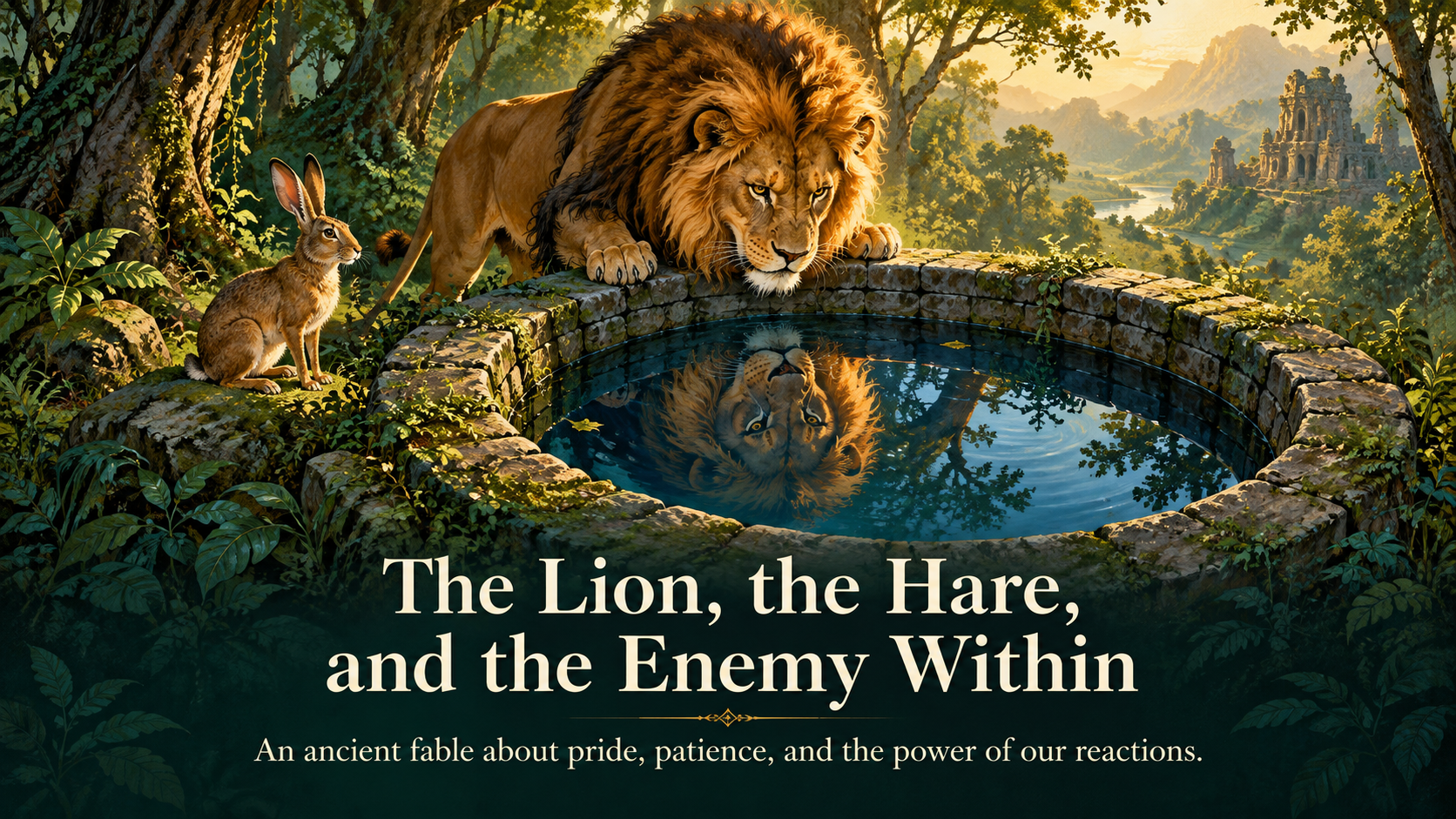
Along the path, the hare came upon an old well. He climbed onto its stone edge and looked down into the water, where his own reflection looked back at him. As he watched the movement below, an idea began to form, and he stayed beside the well until he had considered how to put it into action.
By the time he reached the lion’s cave, the sun was already high, and the lion was furious with hunger. Seeing that the animals had sent only a small hare, and had sent him late, made his anger even worse.
“Why have you kept me waiting for so long, and why have the animals sent such a small creature for my meal?” the lion demanded. “Unless you have a good explanation, I will punish the entire forest for this insult.”
The hare bowed respectfully and asked the lion to hear what had happened before passing judgment.
“The animals knew that I would not be enough to satisfy your hunger, so they sent several hares with me,” he explained. “We were coming here together when another lion stopped us on the way and demanded to know where we were going.”
At the mention of another lion, the hungry ruler stepped closer and listened.
“We told him that we belonged to you and were bringing your meal,” the hare continued. “He laughed at us and said that he was the true ruler of this forest, and that you had no right to claim it.”
The lion’s anger now turned toward this supposed rival, and he demanded to know what had happened next.
“The other lion kept my companions,” the hare replied, “but he allowed me to leave so that I could bring you his challenge. He said that if you believed yourself to be the ruler, you should come and face him.”
The lion could no longer think about his hunger, because the thought of another creature questioning his authority had taken hold of him. He ordered the hare to lead him to the stranger immediately, declaring that there could be only one ruler in the forest.
The hare guided him back along the path until they reached the old well. Pointing toward its opening, he explained that the other lion lived inside a strong shelter and had withdrawn there when he heard them approaching.
The lion climbed onto the edge and looked down. In the water below, he saw what appeared to be another lion staring directly at him, with a small hare standing nearby. He did not stop to examine the scene or consider why the stranger copied his movements, because he had already decided what he expected to find.
He let out a tremendous roar, and the sound echoed back from the well. Convinced that his rival was roaring in defiance, he lost the last of his judgment and leaped into the water to attack him.
The well was deep, and its walls offered no way to climb out. The lion struggled, but his strength could not save him, and he eventually drowned.
The hare returned to the waiting animals and told them what had happened. When they understood that the lion would never threaten them again, their sorrow gave way to relief and celebration. The smallest among them had achieved what they had believed impossible, using observation, patience, and an understanding of the very pride that had made their enemy dangerous.
Why This Story Still Matters in the Real World
The most revealing moment in this story is the moment when the lion looks into the well. Until then, his strength has protected him from almost every consequence, and he has become accustomed to treating his own judgment as unquestionable. When he finally encounters something unfamiliar, he responds with the same aggression that has always worked before, without considering whether the situation requires a different response.
We can recognise this pattern in ordinary life, even when the consequences are less dramatic.
Someone questions our decision at work, and we immediately hear disrespect instead of a useful concern.
A friend disagrees with us, and we begin preparing a defence before understanding what they mean.
A stranger leaves an unpleasant comment online, and we surrender an entire evening to a person whose opinion had no importance until we gave it some.
The danger lies in how quickly wounded pride can turn an event into a personal battle. Once we decide that we must prove ourselves, defeat someone, or have the final word, our choices become narrower.
We may still believe we are acting freely, while our next move is being determined by whoever knows how to provoke us.
The hare succeeds because he understands exactly what the lion cannot tolerate. He does not need to overpower him; he only needs to present a challenge that the lion will feel compelled to answer.
In everyday situations, this is a useful reminder to examine urgency that comes from feeling insulted, because a strong emotional reaction does not automatically mean that immediate action is necessary.
The story also exposes the weakness of leadership built entirely on fear. The lion has obedience, but he has no loyalty, and he mistakes the first for the second. The animals follow his instructions because they are frightened of the consequences, while every one of them wishes to be free of him.
A manager can make the same mistake by treating disagreement as disobedience and demanding approval for every decision.
People may stop raising concerns, but that does not mean the concerns have disappeared. It may mean they have learned that speaking honestly carries more risk than allowing a mistake to continue.
A leader surrounded by agreement can therefore become less informed at precisely the moment they feel most certain.
There is another lesson in the way the forest underestimates the hare. His size makes him appear helpless because the animals have accepted physical strength as the only power that matters. Yet he notices something they have overlooked: the lion’s behaviour is predictable, and that predictability creates an opportunity.
In workplaces, families, and communities, useful insight often comes from people who hold little formal authority. A junior employee may see a failure in a process that senior leaders rarely use, while a person who speaks less often may have been paying close attention throughout the discussion.
When we judge the value of an idea by the status of its speaker, we risk overlooking the observation that could change everything.
The hare’s approach also gives us a practical way to think about problems that initially seem overwhelming. He cannot change his size, remove the lion’s strength, or make the danger disappear by wishing for a different situation. What he can do is observe his surroundings, understand the problem more precisely, and consider a response beyond the obvious choices of fighting or fleeing.
Real situations still require care, because cleverness alone cannot guarantee safety, especially when someone holds substantial power over others. The useful lesson is to seek options:
gather evidence,
understand the rules,
ask for support,
and
consider where collective action might succeed when an individual confrontation would fail.
Perhaps the most uncomfortable reflection belongs to the animals’ arrangement with the lion. Their decision is understandable under threat, yet survival gradually becomes organised around preserving the very system that harms them.
Something similar happens whenever people accept repeated mistreatment as the unavoidable price of keeping a job, maintaining a relationship, or belonging to a group.
The fable asks us to notice when a temporary compromise has become a permanent expectation, and when familiarity has begun to make an unacceptable situation seem normal.
Its final lesson reaches beyond the familiar idea that intelligence can overcome strength.
The lion is destroyed because he cannot question what he sees, cannot pause when challenged, and cannot imagine that his greatest opponent might be his own reaction.
The hare survives because he leaves room for observation before action, and that difference remains useful whenever life places us before something that appears more powerful than we are.