






When Meera returned to Devgarh, the pond behind her childhood home had almost disappeared.
It had once stretched from the old banyan tree to the temple steps, wide enough for children to race paper boats across its surface during the monsoon.
Now it looked like a wound the village had grown accustomed to seeing. Plastic bags clung to the reeds, a green film covered the remaining water, and the cracked earth along the bank held the footprints of cattle searching for something to drink.
Meera stood beside it on the morning after her arrival, holding a cup of tea. She had returned because there was nowhere else she wished to go, although she had told everyone that she had come to look after the house.
Her mother had died two years earlier, her marriage had ended six months ago, and the small design studio she had built with her husband had been registered entirely in his name.
Within a season she had lost the person who raised her, the person she trusted, and the work into which she had poured eleven years of her life.
The neighbours welcomed her with food, concern, and questions disguised as sympathy. How long would she stay? Would she sell the house? Had she spoken to her husband? Was reconciliation still possible? Meera answered politely until politeness began to feel like another job.
After that, she started leaving home before sunrise and walking around the ruined pond, where nobody expected her to explain what had happened.
On the seventh morning, she noticed an old man clearing bottles from the water with a bamboo pole. His name was Harish, though everyone called him Masterji because he had taught science at the village school for more than thirty years.
He wore a faded blue sweater despite the growing heat, and he worked with the patience of someone who did not require visible progress in order to continue.
“You will need a larger basket,” Meera said, looking at the pile near his feet.
“I need fewer people throwing rubbish,” he replied, “but a larger basket is easier to arrange.”
She smiled for the first time since returning home. The next morning she brought him a grain sack. By the end of the week, she was helping him collect plastic, broken sandals, food wrappers, and religious offerings tied inside synthetic cloth.
They worked for an hour each day before the village awakened, speaking only when the work required it. That suited Meera, because Masterji never asked why she had returned or when she planned to leave.
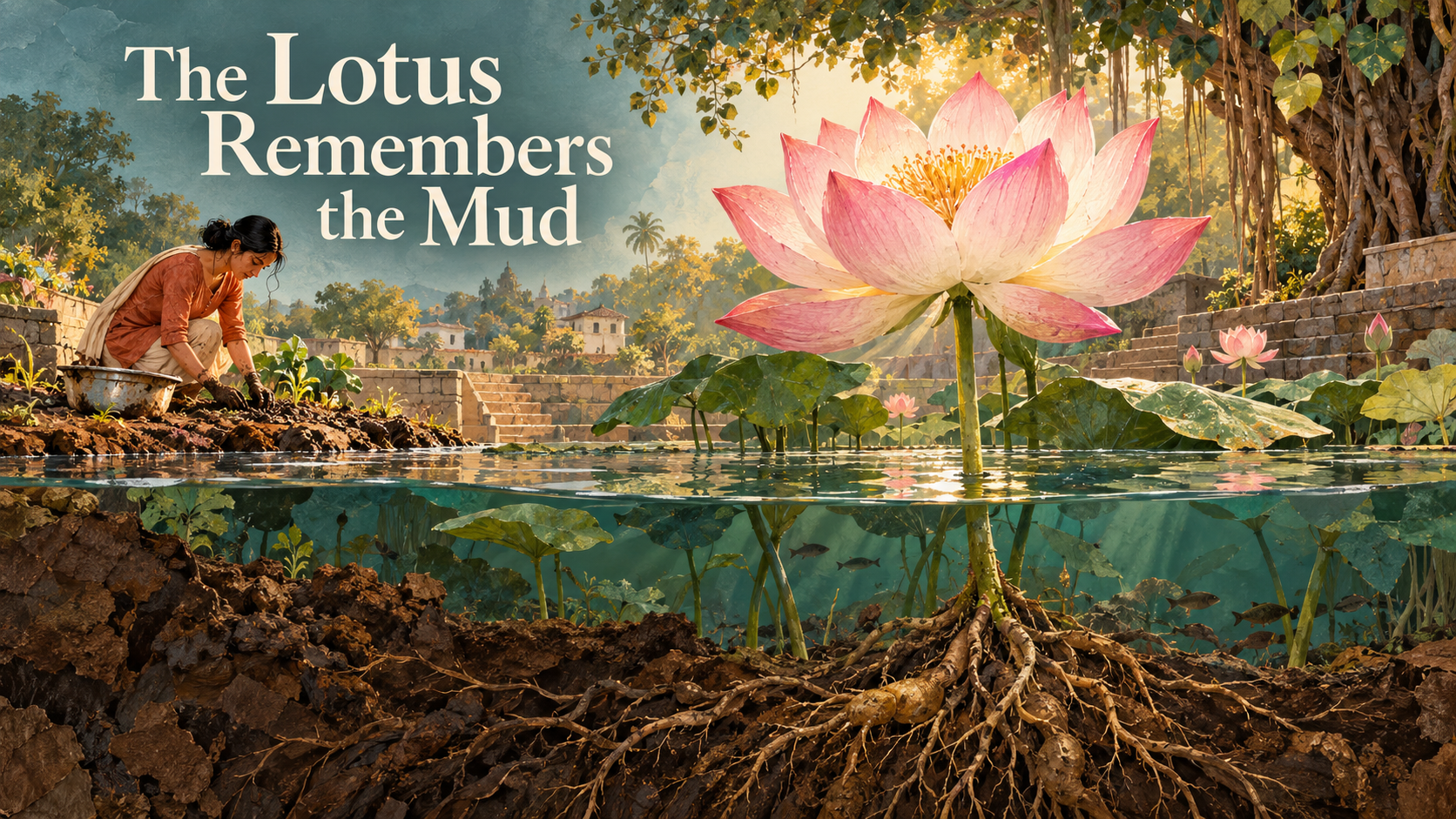
After three weeks, the cleared bank revealed a stone platform that Meera remembered from childhood. Her mother used to sit there in the evenings, her feet resting just above the water, while Meera searched for frogs among the lotus leaves.
The memory arrived so clearly that she had to put down the basket. She could almost hear her mother warning her not to lean too far over the edge, followed by the laugh that always betrayed how little anger the warning contained.
Masterji sat beside her without asking what was wrong. For several minutes they watched a dragonfly move between the reeds.
“My mother loved this pond,” Meera finally said.
“Then she knew it before we neglected it.”
“She knew it when it was beautiful.”
Masterji studied the dark water before answering. “Those are not always different times.”
His words annoyed her, perhaps because they sounded like wisdom when she had no appetite for wisdom.
Beauty was what existed before people disappointed you, before illness entered a house, before promises acquired hidden conditions.
Ruin was what remained afterward.
She had no interest in pretending that pain was secretly a blessing or that every loss arrived carrying a lesson.
She stood, picked up the basket, and returned to work.
As summer advanced, their private effort became harder to ignore. Two schoolchildren joined them one Saturday, followed by their parents the next week. The council sent a tractor, teenagers painted signs, and Meera drew a restoration plan using skills she had believed belonged to her former life.
Work did not erase her grief, but it gave her grief somewhere to place its hands.
There were mornings when she used her anger to lift stones from a blocked channel, and afternoons when memories of her mother sent her to the workshop to sand timber.
On days when she felt ashamed of trusting the wrong person, making decisions reminded her that someone else’s deception had not taken away her judgement.
By the first monsoon rain, water began to return to the pond. It rushed through the cleared channels, brown and impatient, carrying leaves, soil, and small branches. Villagers gathered beneath umbrellas to watch the water level rise. Children cheered when the first paper boat travelled from one bank to the other, though it sank before reaching the temple steps.
Meera watched from the stone platform. She wanted to feel triumphant, but the rain had awakened another memory. Her mother had died during a storm much like this one, while Meera was on a delayed train trying to reach the hospital.
The last conversation between them had been ordinary, almost carelessly so. Her mother had asked whether she was eating properly, and Meera had promised to call the next evening. For two years, she had carried that unfinished promise as if guilt could keep the dead company.
She left the celebration and walked home through the rain.
For several days she did not visit the pond. She kept the curtains closed and ignored the messages on her phone. The restored channels, the benches, and the returning water suddenly seemed meaningless against everything that could not be restored.
No amount of useful work could produce one more conversation with her mother or return the years she had given to a marriage built on deception.
On the fifth morning, someone knocked on her door. Masterji stood outside holding a dented metal bowl filled with black mud.
“I brought you a problem,” he said.
Meera looked at the bowl. “I already have enough.”
“This one needs planting.”
He explained that he had found lotus rhizomes buried near the far bank. They might still grow, but they needed to be placed in heavy soil before being lowered into the pond. Meera nearly refused, yet something about the absurdity of receiving a bowl of mud as medicine made her step aside.
They sat on the veranda with their hands in the wet soil. Masterji showed her how to press each rhizome gently into the mud without burying its growing tip. The work was delicate and unpleasant. Mud gathered beneath her fingernails and streaked her wrists, while rainwater dripped steadily from the roof.
“You said the pond was beautiful even when it was neglected,” Meera said. “I still do not agree.”
“Neither do I,” he replied.
She looked at him, surprised.
“I said beauty and damage can belong to the same time. I did not say damage is beautiful.” He turned the bowl to reach the final rhizome.
“People sometimes praise suffering because they are standing outside it.
Pain is not noble merely because we survive it. Still, once it has entered our life, we may choose what it is allowed to produce.”
Meera pressed the final root into the mud. “And if it produces nothing?”
“Then surviving it was already work.”
They carried the bowl to the pond and lowered it into the shallow water near the stone platform. Nothing changed. The surface closed above it, and the pond appeared exactly as it had a moment earlier.
Weeks passed. Meera continued the restoration, but she stopped measuring her recovery by her productivity. Some days she worked with energy; on others she sat beneath the banyan tree and missed the life she had expected. Healing, she discovered, was not a straight road away from pain, but a wider road with room for anger, affection, disappointment, gratitude, and desire.
She also began accepting small design projects from nearby towns. Her first client wanted a school reading room, and the fee was modest enough to make her former business partner laugh. Meera treated it as if it were a city library, listening to teachers and designing window seats that younger pupils could reach without help.
The room opened in August. A girl with two uneven braids chose a book, settled into a window seat, and became so absorbed that she did not notice the opening speeches. Watching her, Meera felt an emotion she had almost forgotten, not happiness in its effortless form, but satisfaction shaped by attention, labour, and regained trust in her own ability.
When she returned to the pond that evening, a lotus bud stood above the water.
It was smaller than she expected and tightly closed, its pale pink petals holding themselves together against the fading light. Muddy water surrounded its stem. Insects moved across the surface, frogs called from the reeds, and one of the new benches had already been scratched with somebody’s initials. Nothing about the scene was pure, yet the flower did not look diminished by what surrounded it.
Meera visited before sunrise the next morning. Masterji was already there, pretending not to watch the bud. As the sky brightened, the petals slowly opened, revealing a centre the colour of warm sunlight.
“So the mud was useful after all,” Meera said.
“Useful is not the same as good,” he replied. “The flower does not owe the mud gratitude. It simply knows how to draw nourishment from where it has been placed.”
That distinction remained with her.
People would later tell Meera that losing everything had made her stronger, as though betrayal and death deserved credit for the woman she became.
Loss had wounded her, and there was no need to rename that wound as a gift. What changed her was choosing to participate in her own life again, one stone, one message, one plan, and one return to the pond at a time.
By the following spring, lotus flowers covered a wide section of the water. Children once again leaned over the stone platform while anxious parents warned them not to fall.
Meera opened a small studio in her house and hired two young graduates who would otherwise have left Devgarh. Above her desk she kept the dented metal bowl, cleaned but not polished.
On the anniversary of her mother’s death, Meera carried a single lotus to the temple steps.
She did not pray for the past to be altered, nor did she ask to become someone untouched by sorrow. She sat beside the water and spoke aloud the words she had failed to say during their final call.
She spoke of the house, the studio, the reading room, and the pond. She admitted that some mornings still hurt, but the pain no longer convinced her that nothing good could grow beside it.
The flower rested in her lap, spotless above the stem, though its roots had risen from the darkest bed of the pond.
Meera finally understood that wisdom was not the ability to explain suffering. It was the courage to face what had happened without allowing it to dictate everything that could happen next. Suffering had shown her where she had abandoned herself, where trust needed boundaries, and where life still waited for her attention.
As evening settled over Devgarh, lamps appeared in the windows around the pond. Their reflections trembled across the water, breaking and joining again whenever the breeze passed.
Meera remained on the steps until the first stars appeared, then placed the lotus on the surface and watched it drift toward the centre.
The mud remained beneath it, dark, heavy, and unseen. The flower did not deny where it came from, but neither did it return to live below the water.
It opened toward the light, carrying no shame for its roots.