
There is a subtle difference between holding on and truly caring, and most people don’t notice it until life forces them to. What feels like love often carries hidden expectations.
What looks like commitment sometimes turns into control.
What begins as connection slowly becomes dependency.
This is where non-attachment changes the entire experience of being human, because it does not ask you to stop loving, it asks you to love without losing yourself in the process.
Many of us grow up believing that attachment is a sign of depth.
If you care, you hold tight.
If something matters, you protect it.
If you love someone, you need them.
That belief sounds poetic, but it quietly creates tension beneath the surface. When your happiness depends on outcomes, people, or situations behaving in a certain way, you begin to fight reality without even realising it. Every expectation becomes a contract that the world never signed.
Non-attachment shifts this relationship with life. It removes the need to control what cannot be controlled. It allows you to engage fully while accepting that outcomes are never entirely yours to decide.
That shift does not make life distant or cold. It actually makes it more real. You stop arguing with what is happening and start responding to it with clarity.
One of the most immediate changes you notice is in your inner state. The mind becomes less crowded. Instead of constantly replaying how things should have gone or worrying about how they might go wrong, there is space to see things as they are.
That does not mean challenges disappear. It means your reaction to them changes. Stress loses its grip because it is no longer fuelled by resistance. Anxiety softens because it is not fed by imagined futures that must be controlled.
This kind of calm is not passive. It is active acceptance. It is the ability to look at a situation, understand it clearly, and act without emotional noise distorting your thinking. When the mind is not overloaded with attachment, it does not jump to conclusions or spiral into worst-case scenarios. It observes, processes, and responds.
Emotional suffering often comes from the gap between expectation and reality. When things don’t go your way, the pain is rarely just about the event itself. It is about the story you built around it. The promotion you thought was guaranteed, the relationship you believed would last, the outcome you were certain would happen. Attachment strengthens that story, making any deviation feel like a personal loss rather than a natural shift.
Non-attachment does not remove emotions. You still feel disappointment, sadness, and frustration. The difference is that these emotions do not overwhelm you. They pass through without taking control. You experience them without becoming them. That space between feeling and identity is where resilience begins to grow.
Life is unpredictable. Plans change, people change, circumstances shift without warning. When you are deeply attached to specific outcomes, every unexpected turn feels like a setback. It feels like something is breaking. But when you are less tied to outcomes, change becomes easier to navigate. You adjust faster because you are not stuck holding on to what was supposed to happen.
Resilience, in this sense, is not about being tough. It is about being flexible. It is about understanding that strength comes from adaptation, not resistance.
When you are not anchored to a single version of how life should look, you become capable of moving forward even when things fall apart. You recover faster because you are not carrying the weight of rigid expectations.
Relationships are another area where the impact of non-attachment becomes clear. Many conflicts do not come from lack of love. They come from fear, insecurity, and the need to control. When attachment turns into dependency, it creates pressure.
You begin to expect the other person to behave in ways that protect your emotional state. You want reassurance, consistency, and certainty at all times. When those expectations are not met, tension builds.
Non-attachment changes how you show up in relationships. You still care deeply, but you do not try to control. You give space without withdrawing. You support without clinging. This creates a different kind of connection, one that is based on trust rather than fear. When both people feel free to be themselves without the pressure of constant expectation, the relationship becomes more stable and genuine.
This does not mean you tolerate everything or accept unhealthy behaviour. Non-attachment is not about ignoring problems. It is about approaching them without emotional dependency. You can set boundaries, make decisions, and walk away if needed, but those actions come from clarity rather than desperation.
Another important shift happens in decision-making. When you are overly attached, emotions cloud judgment. You may ignore facts because they do not align with what you want. You may make impulsive choices to protect something you are afraid to lose. You may stay in situations longer than you should because letting go feels like failure.
With non-attachment, decisions become more balanced. You are able to look at situations objectively, weighing both emotional and practical aspects without being overwhelmed by either. This does not make you cold or detached from life. It makes you grounded. You respond instead of reacting. You choose instead of clinging.
Perhaps the most powerful transformation is in how you experience freedom. When your sense of happiness depends on external factors, you are constantly at risk of losing it. Your mood rises and falls based on what happens around you. This creates a fragile sense of well-being, one that can be disrupted at any moment.
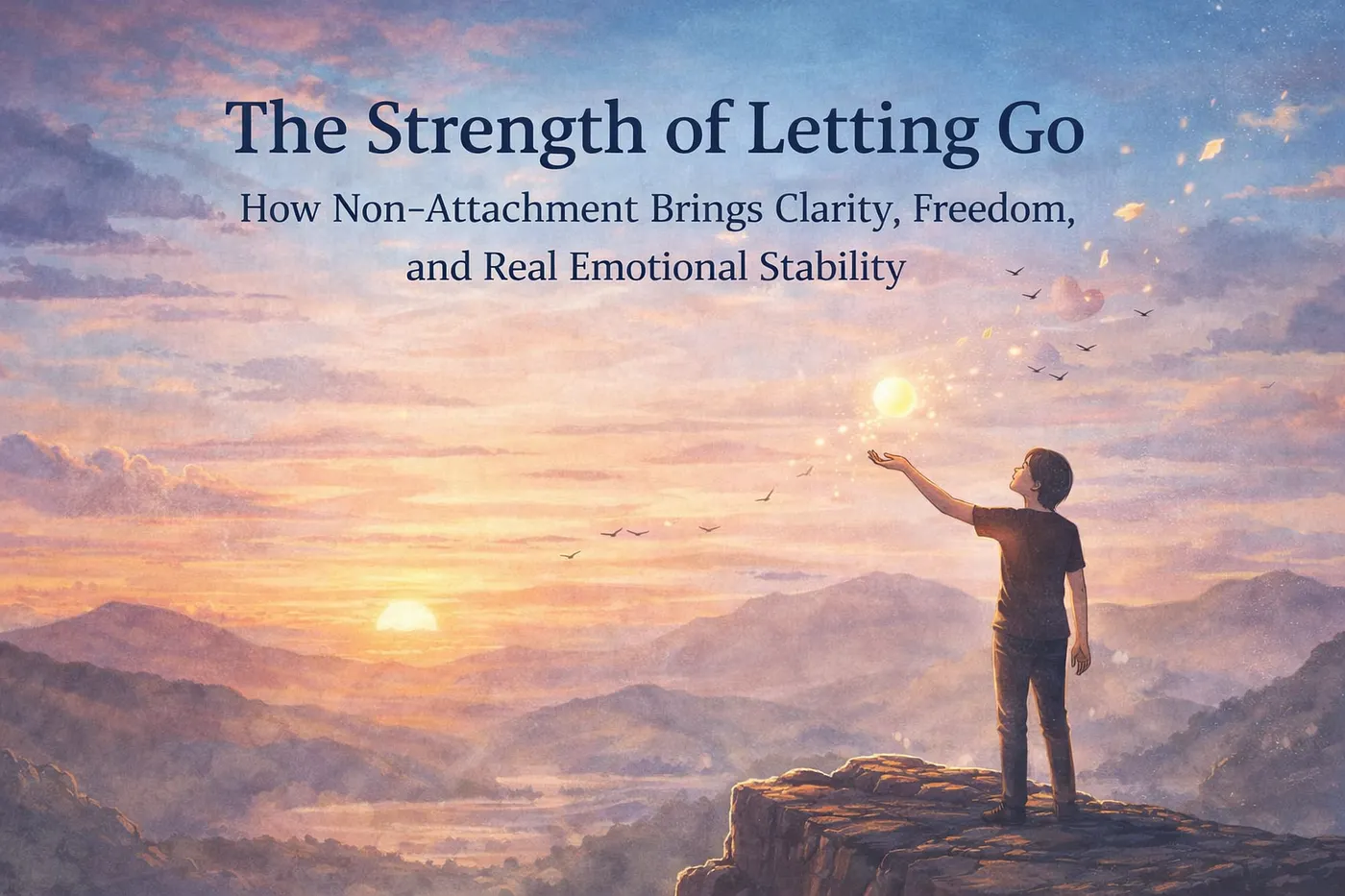
Non-attachment brings a different kind of freedom. It is the understanding that your inner state does not have to be controlled by external circumstances. You can enjoy success without becoming dependent on it. You can experience love without fearing its loss every moment. You can pursue goals without attaching your entire identity to the outcome.
This freedom is not about withdrawing from life. It is about participating fully without being owned by it. You still care, still strive, still connect, but you are not trapped by the need for things to go a certain way. That space allows you to experience life more deeply, because you are not constantly trying to manage it.
Letting go of attachment does not happen overnight. It requires awareness. It requires noticing where you are holding on too tightly, where your expectations are creating pressure, where your emotional state is tied to things outside your control. Once you start seeing these patterns, change becomes possible.
It is not about becoming indifferent. It is about becoming aware. You learn to care without losing perspective. You learn to engage without becoming dependent. You learn to accept without giving up.
In the end, non-attachment is not a concept to be understood once and forgotten. It is a practice. It shows up in small moments, in how you react to delays, how you handle disagreements, how you process setbacks, how you experience success. Over time, these small shifts create a different way of living.
Life does not become easier in the sense that problems disappear. It becomes easier because you are no longer fighting every change, every outcome, every uncertainty. You move with life instead of against it. And in that movement, there is a sense of stability that does not rely on everything going right.
That is where real strength comes from. Not from controlling everything, but from being able to stand steady even when things are uncertain. Not from holding on tighter, but from knowing when to let go. Not from avoiding emotions, but from experiencing them without being consumed by them.
Non-attachment does not take anything away from your life. It gives you the ability to experience it more fully, without the constant weight of fear, expectation, and control. And once you feel that shift, even briefly, it becomes clear that this is not about losing connection. It is about discovering a deeper, more stable way of being connected to everything around you.