




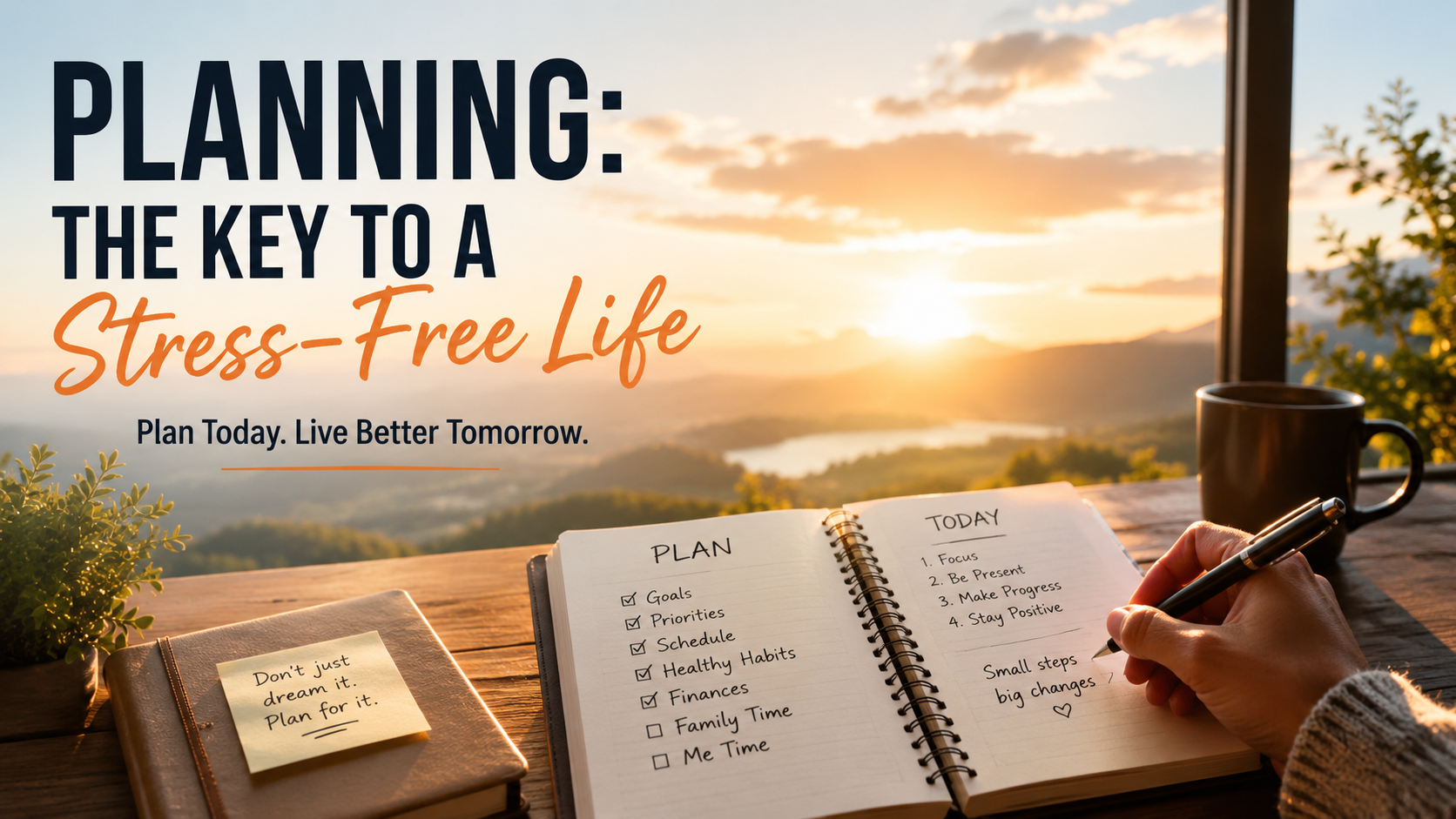
How Simple Planning Brings Clarity, Reduces Stress, and Helps You Build the Life You Want
Life does not usually become stressful because we have too many dreams, too many responsibilities, or too many things we want to achieve; it becomes stressful when all of those things sit in our mind without structure, fighting for attention at the same time, making even ordinary days feel heavier than they need to be.
One unfinished task reminds us of another, one forgotten commitment creates pressure in the background, and one vague goal keeps following us around because we have never turned it into something clear enough to act on.
This is where planning becomes more than a productivity habit, because a good plan gives shape to the scattered pieces of life and helps us move through the day with a little more control, a little more direction, and a lot less unnecessary stress.
Many people misunderstand planning because they think it means controlling every minute, removing spontaneity, or turning life into a strict routine where there is no space to breathe. In reality, planning is not about making life rigid; it is about making life easier to manage.
A plan does not promise that everything will go perfectly, because no honest person can promise that, but it does give you a better way to respond when things change, when priorities shift, or when the day becomes more demanding than expected.
Without a plan, the smallest disruption can feel like a crisis, while with a plan, even a difficult day can be handled with more patience because you already know what matters, what can wait, and what needs your attention first.
Planning Gives Direction to Your Life
A life without direction can still look busy from the outside, but being busy is not the same as moving forward. Many people spend their days answering messages, running errands, attending meetings, dealing with last-minute requests, and completing random tasks, yet they still end the week feeling as if they have not made real progress.
The problem is not always lack of effort; often, the problem is lack of direction. When you do not know where your time is supposed to go, it gets taken by whatever is loudest, easiest, or most urgent in the moment.
Planning helps you turn vague hopes into clear actions, and that shift alone can change the way you approach your day. Saying “I want a better life” sounds meaningful, but it is too broad to guide your behaviour on a Tuesday morning when you are tired, distracted, and already late for something.
Saying “I will walk for thirty minutes after work, save a fixed amount this month, and spend one hour learning a useful skill three evenings a week” gives your mind something practical to follow. The dream remains important, but the plan turns it into steps you can actually take.
Direction also reduces the emotional weight of decision-making. When you wake up with no plan, every task becomes a question, and every question consumes energy before you have even started working.
Should I exercise today or tomorrow?
Should I reply to this email now or later?
Should I work on my goal or finish household chores first?
By the time you have argued with yourself for half the morning, your energy has already dropped. A simple plan removes many of these daily negotiations because your priorities are already chosen before the pressure of the day begins.
Planning Saves Time and Reduces Stress
Stress often grows in the gap between what needs to be done and what we have prepared for. When we leave everything until the last minute, we do not just lose time; we also lose calmness, confidence, and the ability to think clearly.
A task that could have been simple on Monday becomes stressful on Friday because now it has urgency attached to it. A bill that could have been paid easily becomes a source of panic when the reminder arrives late. A conversation that could have been handled calmly becomes uncomfortable because we avoided it for too long.
Planning helps because it moves responsibility from memory into structure. Instead of relying on your mind to hold every task, appointment, deadline, and promise, you place those things into a system you can trust.
This could be a notebook, a calendar, a simple notes app, or a weekly checklist, because the tool matters less than the habit of capturing what needs to be done.
Once your responsibilities are written down and arranged, your mind no longer has to keep repeating them in the background like an alarm that never fully switches off.
A planned day also protects you from overcommitting, which is one of the biggest hidden causes of stress. Many people say yes to too much because they do not have a clear view of what is already on their plate. Planning shows you the truth about your time.
When you can see that your week already contains work deadlines, family commitments, personal errands, and rest time, you become more realistic about what you can accept. This does not make you lazy or unhelpful; it makes you honest with your capacity, and that honesty prevents resentment later.
Planning Improves Focus and Productivity
Without a plan, distractions easily become the plan. You may begin the day intending to do something meaningful, but then a message appears, a notification pulls your attention, a small task looks easier than the important one, and suddenly half the day disappears into activity that was never truly chosen. This is how people end up exhausted without feeling productive, because they worked all day but did not work on what mattered most.
Planning improves focus because it gives your attention a destination. When you decide in advance what your most important tasks are, you are less likely to be pulled away by everything that looks urgent.
This does not mean you will ignore genuine emergencies, but it does mean you will stop treating every small interruption as if it deserves the same place in your day. A planned person is not someone who does more things than everyone else; a planned person is someone who knows which things deserve priority.
Productivity is not about filling every hour with work, and it is not about turning yourself into a machine that never rests. Real productivity means using your energy on the right things at the right time. Planning helps you match tasks with energy levels, which is something many people overlook.
Deep work, important decisions, creative thinking, and difficult conversations usually need better mental energy, while smaller administrative tasks can often be handled during lower-energy parts of the day. When you plan with this in mind, you stop forcing important work into the worst hours and then blaming yourself for struggling.
Planning also reduces the waste caused by constant task-switching. Every time you jump from one thing to another, your mind needs time to adjust, and that adjustment often costs more focus than you realise.
A simple plan that groups similar tasks together can make your day feel smoother, because you are not asking your brain to restart every few minutes. Replying to messages in one block, handling errands together, setting aside focused time for important work, and leaving space for breaks can help you finish more without feeling scattered.
Planning Helps You Make Better Decisions
Good decisions are rarely made in panic. When emotions are high, time is short, and pressure is building, most people choose whatever gives immediate relief, even if it creates bigger problems later.
Planning helps because it gives you a chance to think before the situation becomes urgent. You can consider options, notice risks, compare consequences, and create backup choices while you still have the mental space to be sensible.
This matters in everyday life more than people admit. Financial stress is easier to manage when there is a monthly budget and a savings plan. Health goals become more realistic when meals, exercise, and sleep are considered before the week becomes crowded.
Work becomes less chaotic when deadlines are broken into smaller parts instead of being faced all at once. Even relationships benefit from planning, because making time for people, important conversations, and shared responsibilities prevents neglect from building slowly in the background.
Planning does not remove emotion from life, and it should not, because emotions are part of being human. What planning does is stop emotion from becoming the only driver of action. When you already know your priorities, you are less likely to make choices based only on tiredness, frustration, fear, or temporary excitement. You can still change your mind, but you change it with awareness rather than impulse.
Better decisions also come from seeing trade-offs clearly. Every yes contains a no somewhere else, whether we admit it or not. If you say yes to another commitment, you may be saying no to rest, family time, focused work, or personal growth.
Planning makes these trade-offs visible, and once they are visible, you can choose with more maturity. This is not about becoming selfish; it is about understanding that your time is limited and your choices should reflect what you truly value.
Planning Builds Confidence and Motivation
Confidence does not only come from big achievements; it also comes from keeping small promises to yourself. When you plan something realistic and follow through, even in a small way, your mind receives proof that you can trust yourself.
That proof builds slowly, but it becomes powerful over time. You begin to feel less like life is happening to you and more like you have some influence over where you are going.
This is especially important when life feels difficult. During challenging seasons, motivation often disappears because the bigger goal feels too far away. Planning brings the focus back to the next step, and sometimes the next step is exactly what a person needs to keep moving.
You may not be able to solve everything today, but you can make one phone call, complete one task, prepare one document, take one walk, or save one small amount. Progress becomes visible, and visible progress gives encouragement.
A plan also gives you a way to measure growth without waiting for a dramatic result. If your goal is to become healthier, you do not need to wait six months to feel proud; you can notice that you exercised three times this week, cooked more meals at home, or slept earlier than usual.
If your goal is career growth, you can track applications, learning hours, networking conversations, or projects completed. These small markers matter because they show that your effort is not disappearing into the air.
Motivation often follows action, not the other way around. Many people wait to feel motivated before they begin, but planning helps you begin even when motivation is weak. Once you take action and see progress, motivation usually grows naturally.
This is why a simple plan can be more useful than a long speech about inspiration, because inspiration may make you feel good for a moment, while structure helps you continue after that feeling fades.
Planning Helps You Handle Change
Some people avoid planning because they believe life is unpredictable, and since things can change, they feel there is no point making plans. This sounds logical at first, but it misses the real purpose of planning.
Planning is not valuable because life always follows the plan; planning is valuable because it helps you adjust when life does not follow the plan. A person with no plan is often shocked by change, while a person who has thought ahead can shift priorities more easily.
Flexibility is not the opposite of planning. In many ways, flexibility is one of the benefits of planning. When you know what matters most, you can rearrange the smaller things without losing direction. When you know your deadlines, you can move tasks before they become urgent. When you understand your commitments, you can decide what to postpone, delegate, simplify, or cancel when unexpected events appear.
A good plan should always leave room for real life. If your schedule is packed so tightly that one delay ruins the whole day, that is not planning; that is pressure disguised as organisation. Life includes traffic, illness, family needs, technical problems, emotional tiredness, and tasks that take longer than expected.
A practical plan respects this by creating space, setting realistic expectations, and allowing recovery time. The goal is not to control every moment, but to reduce avoidable chaos.
Handling change well also requires reviewing your plan instead of treating it like a permanent contract. A weekly review can help you ask useful questions:
What worked this week?
What did I underestimate?
What needs to move?
What should I stop doing?
What deserves more attention next week?
These questions help you learn from experience rather than repeat the same stressful pattern again and again.
How to Build a Simple Planning Habit
Planning does not need to be complicated to be useful. In fact, complicated planning often fails because it becomes another task to maintain. A simple approach is usually better: write down what needs to be done, choose what matters most, place tasks into realistic time blocks, and review the plan regularly. Even ten minutes of planning can save hours of confusion later.
Start with a weekly plan because it gives enough space to see the bigger picture without becoming overwhelming. Look at your work, personal responsibilities, appointments, health needs, money commitments, and family time. Then choose a few priorities that matter most for the week. These priorities should not be too many, because a plan with twenty urgent priorities is just stress written neatly on paper.
After that, create a daily plan that supports the week. Each day should have a small number of important tasks, some routine responsibilities, and space for the unexpected. It is better to finish three meaningful things than to write fifteen tasks and feel like a failure by evening. Planning should help your confidence, not become a daily reminder that you expect too much from yourself.
It also helps to plan rest, because rest is usually the first thing people sacrifice when life becomes busy. This is a mistake because tired people make poorer decisions, lose focus faster, and feel more stressed by normal responsibilities.
A balanced plan includes sleep, breaks, meals, movement, relationships, and time away from screens. These are not rewards you earn after destroying yourself with work; they are part of the foundation that allows you to function well.
Conclusion
Planning will not make life perfect, and anyone who says otherwise is selling a fantasy that real life will quickly disprove. There will still be delays, difficult days, unexpected problems, emotional moments, and seasons where even the best plan needs to be changed.
But planning can make life clearer, calmer, and more manageable. It turns vague dreams into practical steps, reduces the stress of forgotten responsibilities, improves focus, supports better decisions, builds confidence, and helps you respond to change without feeling completely lost.
A stress-free life does not mean a life without responsibilities. It means a life where responsibilities are handled with more awareness, where priorities are chosen instead of guessed, and where your mind is not forced to carry everything alone.
A simple plan gives your day direction, gives your effort meaning, and gives your future a better chance of becoming something you intentionally build rather than something you accidentally fall into. When you plan with purpose, you are not trying to control life; you are giving yourself a better way to live it.