



Before Notifications, Before Algorithms, Before Life Became a Race
There was something strangely beautiful about growing up in India during the 1990s. Not luxurious. Not fast. Not glamorous. But deeply human.
Life did not arrive through touchscreens. It arrived through people.
Through neighbours who entered your house without calling first. Through mothers shouting your full name from the balcony when the streetlights came on. Through fathers who repaired old radios instead of throwing them away. Through cousins sleeping on thin mattresses during summer vacations while one ceiling fan tried its best to save everybody from the heat.
The 90s in India were not perfect. Power cuts happened. Cable TV signals disappeared during rain. Landline phones worked according to their mood. School bags felt heavier than emotional trauma. Yet somehow, those years left behind memories stronger than most modern luxuries.
Because people had less. But they felt more.
Mornings Smelled Different Back Then
A typical morning in a 90s Indian household had its own soundtrack.
Pressure cooker whistles.
Doordarshan news playing in the background.
The metallic sound of milk bottles being dropped outside the door.
Mothers rushing between kitchen and school uniforms.
Fathers reading newspapers like national policy depended on them personally.
Children pretending stomach pain to avoid school tests.
Nobody woke up by scrolling social media. Most children woke up because someone literally pulled the blanket away.
There were no smart speakers announcing weather updates. The weather forecast was your grandmother standing outside the house saying, “Aaj baarish lagegi.”
And honestly, she was usually more accurate.
Breakfast was simple. Parathas. Bread-butter. Poha. Upma. Sometimes Maggi if life was feeling adventurous. Eating outside was a luxury, not a coping mechanism for stress.
Even middle-class homes carried dignity in simplicity.
Steel utensils.
Plastic water bottles kept in fridge trays.
Godrej cupboards.
Television covered with embroidered cloth when guests arrived.
And somewhere in every house, there was that mysterious plastic bag full of smaller plastic bags.
Nobody questioned it. It was national culture.
Entertainment Was Not Personalized. It Was Shared
Today every person watches separate content on separate screens in separate rooms.
The 90s were different.
Entertainment was collective.
One TV. One remote. One national debate.
Families planned evenings around television schedules because you could not pause anything. If you missed your favourite show, you missed it. Finished. No replay. No streaming platform waiting patiently for your convenience.
Sunday mornings belonged to mythology and nostalgia.
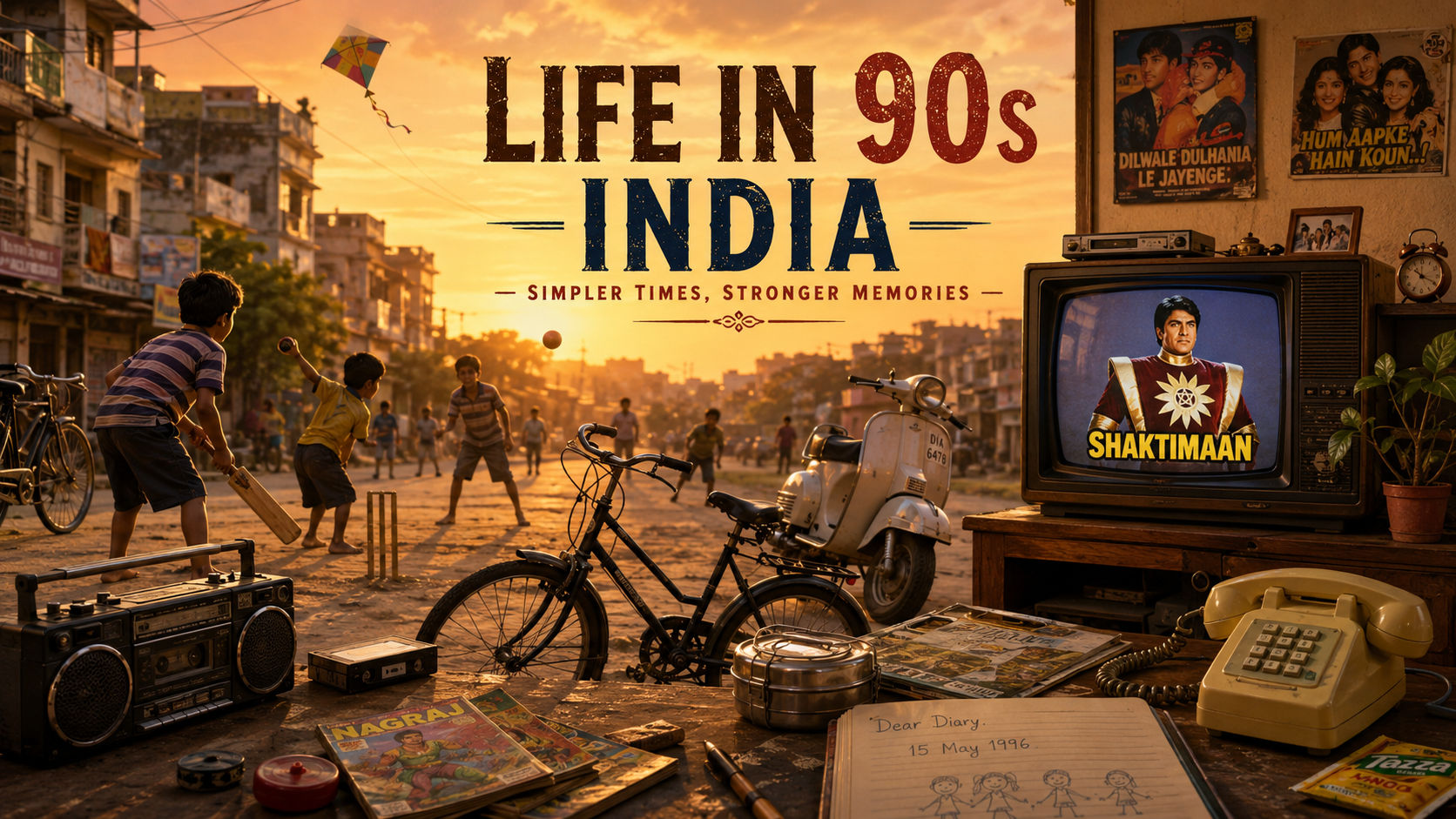
Entire streets became silent during shows like Shaktimaan, Mahabharat, and Ramayan.
Children wore towels like superhero capes after watching Shaktimaan and genuinely believed spinning around could unlock secret powers.
Cable TV slowly entered homes like a revolution.
Suddenly the world became larger.
Tom and Jerry, Captain Planet and the Planeteers, DuckTales, Small Wonder.
And then came music channels.
Every teenager suddenly became emotionally attached to songs they barely understood.
There was patience in entertainment back then. Anticipation. Waiting.
That waiting made joy stronger.
Childhood Happened Outdoors
This generation has screen time reports.
The 90s had sunset deadlines.
Children disappeared after homework and returned home covered in dust, sweat, scratches, and happiness.
Cricket in narrow lanes.
Football in empty plots.
Cycling races.
Hide and seek.
Marbles.
Stapu.
Gilli-danda.
Badminton with broken rackets and eternal arguments about whether the shuttle touched the line.
Nobody needed expensive gaming setups because the entire neighbourhood was the playground.
And every colony had that one angry uncle who threatened to confiscate the cricket ball.
Every single colony.
Friendships felt more physical back then. Not because emotions were deeper, but because life demanded presence. You had to knock on doors and ask, “Aunty, woh bahar aa sakta hai?”
Sometimes your friend was not allowed outside.
Sometimes his mother forced all of you to drink Rasna before playing again.
Those moments looked ordinary while they were happening.
Years later, they became emotional treasure.
Summer Vacations Felt Infinite
Modern vacations are mostly photographs.
90s vacations were experiences.
Train journeys itself felt like an event.
Families travelled carrying giant steel tiffins packed with homemade food because buying outside food too often felt financially irresponsible.
Children fought for window seats.
Vendors shouted “chai chai,” “samosa,” and “cold drinks.”
Parents warned kids not to lean outside the train even though every child still tried.
Visiting grandparents during summer holidays felt magical.
Cousins reunited like unfinished chaos resuming naturally.
Terrace conversations.
Mangoes in buckets of cold water.
Hand pumps.
Power cuts leading to family storytelling sessions under the stars.
Nobody said “quality time.”
People simply lived together.
There is a difference.
The Middle Class Dream Was Simple
The Indian middle class during the 90s lived carefully.
Parents calculated expenses mentally faster than modern calculators.
Buying a scooter felt like achievement.
Owning a refrigerator meant progress.
Getting a telephone connection sometimes took years.
Children were raised with constant reminders:
“Pankha band karo.”
“Bijli ka bill aayega.”
“Paise ped pe nahi ugte.”
Every object had value because money had visible effort attached to it.
Most parents carried silent sacrifices children understood only after becoming adults themselves.
Fathers repeated the same two pairs of shoes for years while making sure children had school books on time.
Mothers adjusted budgets like financial strategists without ever receiving titles for it.
Luxury was not defined by brands.
It was defined by stability.
Festivals Felt Bigger Than They Do Today
Maybe because people participated more emotionally.
Diwali was not only about Instagram aesthetics. Homes genuinely smelled of fresh paint, diyas, sweets, and excitement.
Holi meant entire neighbourhood alliances and revenge plans involving water balloons.
Raksha Bandhan involved cousins, laughter, and awkward family photos.
Eid meant sharing food with neighbours.
Christmas meant school functions and paper stars.
Festivals created community interaction naturally because life itself was less isolated.
People visited each other physically. Not digitally.
Schools Were Strict, Funny, and Weirdly Memorable
90s schools operated on fear, discipline, and accidental comedy.
Teachers threw chalk pieces with sniper-level accuracy.
PT periods disappeared mysteriously whenever syllabus pressure increased.
Report cards could destroy household peace for an entire week.
Every child knew the terror of hearing:
“Bring your parents tomorrow.”
And somehow every classroom had the same personalities.
The topper.
The backbench comedian.
The silent artist.
The class monitor who treated authority like government service.
The kid who always forgot homework.
School friendships became permanent emotional architecture for many people. Because those friendships formed before status, salaries, politics, and social media performances entered life.
Children knew each other as humans first.
Not profiles.
Technology Was Slow, But Wonder Felt Bigger
The arrival of new technology during the 90s felt exciting because it arrived gradually.
Computers were mysterious.
Internet cafes felt futuristic.
Dial-up internet sounded like robots fighting inside telephone wires.
Video games were shared experiences.
Super Mario Bros., Contra, Road Fighter.
One cassette could entertain an entire group of children for months.
Photographs were limited because film rolls were expensive. That limitation made photos valuable.
Nobody clicked twenty versions of the same pose.
Moments mattered more than documentation.
Ironically, fewer photos created stronger memories.
Life Was Slower, But Minds Were Less Crowded
The 90s had problems.
But constant mental noise was not one of them.
People were not exposed to thousands of opinions every hour.
Children were not comparing their lives with influencers sitting in Dubai cafes pretending to be motivational speakers.
Most families focused on survival, education, respect, and stability.
That simplicity protected mental peace in ways nobody appreciated at the time.
Boredom existed.
And boredom created imagination.
Children invented games.
Teenagers sat silently on terraces thinking about life.
People learned patience naturally because everything was slower.
Letters took time.
Results took time.
Career growth took time.
Even relationships developed slowly.
Not every silence needed filling.
The Emotional Weight of Looking Back
People who grew up in 90s India often become emotional when discussing those years because they are not only remembering a decade.
They are remembering a feeling.
A version of life that disappeared quietly.
A time before adulthood became exhausting.
Before people became permanently reachable.
Before family dinners competed against mobile screens.
Before happiness became performative.
The nostalgia is not about wanting black-and-white televisions again or standing in queues for movie tickets.
It is about missing emotional closeness.
Missing simplicity.
Missing the strange warmth of ordinary days.
The 90s were not richer in money.
They were richer in presence.
And maybe that is why those memories refuse to fade.
Because deep down, many people are not actually missing the decade.
They are missing who they were during it.