

A timeless story about impatience, power, and the hidden cost of solving the wrong problem
Life often teaches its most powerful lessons through simple stories. These stories may involve animals, ordinary situations, and small decisions that appear harmless at first, yet beneath the surface they reveal patterns that exist everywhere in human life. Sometimes the wisdom inside such stories is stronger than any lecture about strategy, leadership, or personal growth.
One such story speaks about a horse, a deer, and a man. At first it seems like a small conflict over a meadow. But if you look deeper, it reveals an important truth about life, business, relationships, and power.
The truth is simple but uncomfortable.
Sometimes the price of winning a small conflict is far greater than the problem we were trying to solve.
Understanding this idea can change the way we approach decisions, partnerships, and even everyday arguments.
A Peaceful Meadow That Once Meant Freedom
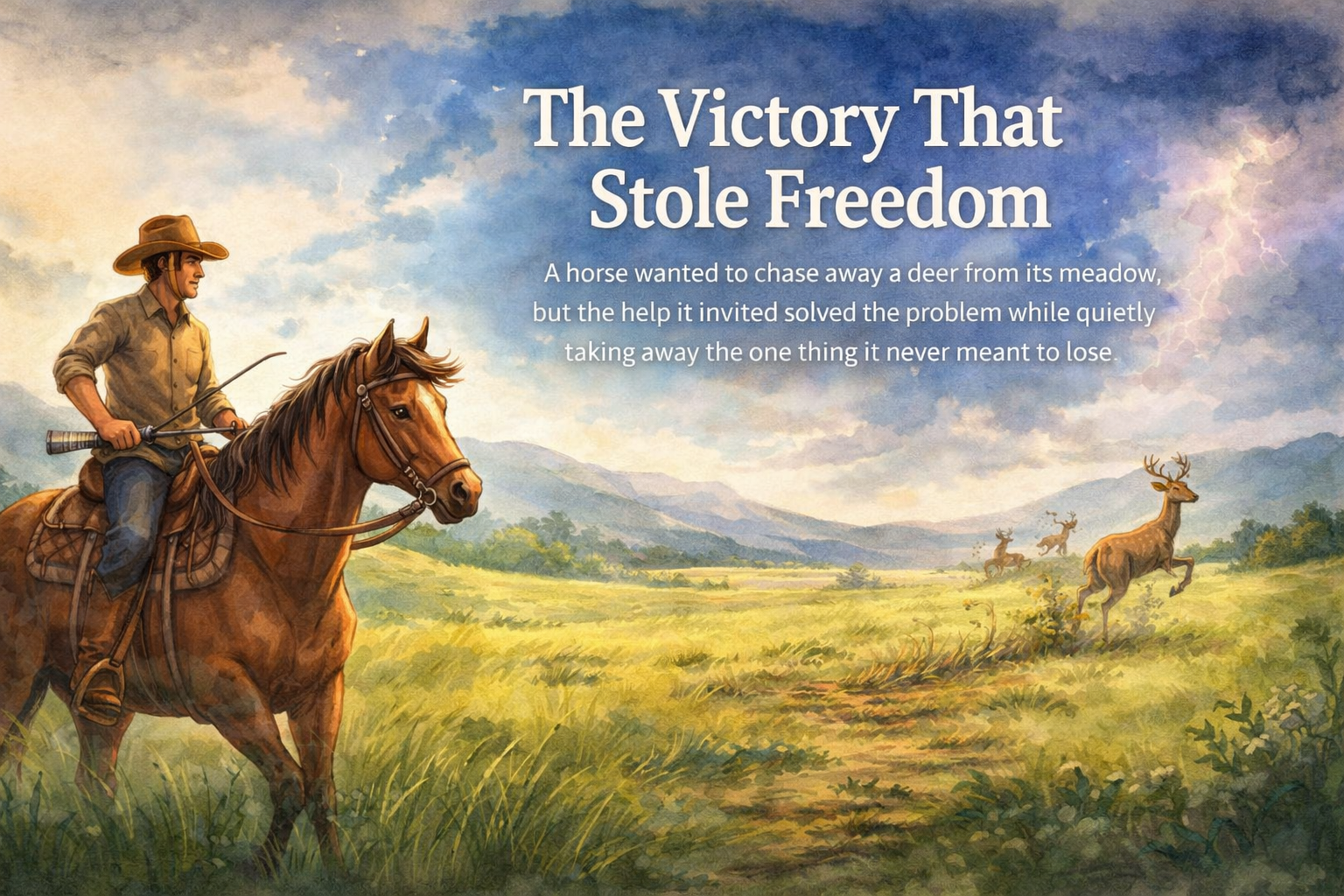
Long ago, a strong horse lived in a wide green meadow surrounded by rolling hills and tall grass that moved gently with the wind. The meadow was large enough for endless running and rich enough to provide more than enough grass for the horse to graze comfortably.
Every morning the horse woke to golden sunlight spreading across the land. It wandered freely from one end of the meadow to the other, eating fresh grass, stretching its legs, and enjoying a life without boundaries.
There were no fences around the field. There were no ropes tied around its neck. There were no reins pulling its head in directions it did not choose.
Freedom was not something the horse thought about consciously, because freedom had always been part of its life.
But peaceful environments often change when something unexpected arrives.
The Deer That Disturbed the Meadow
One afternoon, a deer began visiting the meadow.
At first the horse barely noticed the visitor. The deer would enter quietly from the edge of the forest, nibble on some grass, and then disappear again among the trees.
The horse assumed it was only passing through.
But the visits continued.
Soon the deer returned every day. It ran across the meadow with powerful leaps, trampling patches of grass and eating from the same areas where the horse preferred to graze.
The horse tried chasing the deer away several times. Each time the deer simply ran faster, disappearing into the forest before the horse could get close.
Days passed, and the situation began to irritate the horse more and more.
The meadow that once felt peaceful now felt disturbed.
The horse began thinking about the deer constantly. Every time the grass moved, the horse expected the deer to appear again.
What had once been a small inconvenience slowly became a problem that filled the horse’s thoughts.
The Moment When Frustration Turns Into Action
Problems grow larger when they remain unsolved for too long. Even a small disturbance can begin to feel overwhelming when it repeats again and again.
The horse reached a point where patience disappeared.
One day, after watching the deer run through the meadow once more, the horse decided it needed help.
Near the edge of the meadow lived a man who had often walked through the land. The horse had seen him before carrying tools, ropes, and weapons used for hunting.
The horse approached the man and tried to communicate its frustration.
The man listened carefully and seemed to understand what the horse wanted.
“You want the deer gone,” the man said thoughtfully.
The horse nodded eagerly.
The man paused for a moment before offering a solution.
“I can help you chase the deer away,” he said. “But if I am going to guide you properly, I must place a bit in your mouth and a saddle on your back so I can ride you.”
The horse hesitated only briefly.
It had never worn a saddle before. Nothing had ever been placed in its mouth or on its back.
But the horse’s mind focused on only one thing.
The deer had to leave.
So the horse agreed.
The Problem Is Solved
The man quickly prepared the horse.
A metal bit was placed in its mouth and connected to leather reins. A saddle was fastened tightly on its back. Then the man climbed onto the horse and held the reins firmly.
The horse felt strange carrying the weight of a rider, but it ignored the discomfort because the solution to its problem was finally within reach.
Soon the deer appeared again in the meadow.
This time the chase began immediately.
With the man guiding its direction and pushing it forward, the horse ran faster and more strategically than ever before. Together they pursued the deer across the meadow and toward the forest.
The deer quickly realized the meadow was no longer a safe place.
Within a short time, it disappeared into the forest and never returned.
The horse felt proud.
The problem that had caused weeks of frustration was solved in a single afternoon.
Victory felt satisfying.
But the real story had not ended yet.
The Cost of Victory
After the chase ended, the horse expected the man to remove the saddle and loosen the straps so everything could return to normal.
The deer was gone.
The meadow was peaceful again.
But when the horse looked back toward the man, something unexpected happened.
Instead of removing the saddle, the man tightened the reins.
“My friend,” he said calmly, “now I see how useful you are.”
The horse suddenly felt a deep sense of confusion.
“From today onward,” the man continued, “you will work for me.”
In that moment, the horse understood its mistake.
The deer was gone, but something much more important had disappeared as well.
The horse had traded its freedom for a solution.
The meadow still existed.
But the horse no longer ran through it freely.
The saddle stayed on its back.
The bit stayed in its mouth.
And the reins now belonged to someone else.
The Hidden Lesson About Power and Control
This story carries an important lesson that appears again and again in human life.
When people invite powerful forces into their lives to solve a problem, those forces often gain control that is difficult to take back.
In business, companies sometimes invite powerful investors to solve financial pressure, only to lose control over the direction of their company.
In professional environments, people may rely on authority figures to resolve conflicts, only to become dependent on that authority.
In personal life, individuals sometimes involve outsiders to solve disagreements, only to realize later that those outsiders now influence decisions that once belonged to them alone.
The pattern looks simple.
A problem appears.
Frustration grows.
A powerful solution becomes available.
And the long-term cost of that solution remains hidden until it is too late.
Why People Focus on Short-Term Solutions
Human minds naturally focus on removing immediate discomfort.
When something disturbs our environment, our first instinct is to eliminate the problem as quickly as possible. That instinct works well when escaping physical danger, but it can lead to poor decisions when dealing with complex situations.
The horse focused only on removing the deer.
It did not consider what it was giving up in exchange for that solution.
The saddle looked temporary.
The bit looked harmless.
The arrangement looked simple.
But the moment control enters a relationship, the balance of power changes.
And once that balance shifts, returning to the previous state becomes very difficult.
Small Conflicts That Lead to Bigger Losses
Many people repeat the horse’s mistake in everyday life.
Someone may destroy an important relationship over a small disagreement.
A professional may leave a promising opportunity because of temporary frustration.
A business owner may give away ownership to solve a short-term financial issue.
In each situation, the person believes they are solving a problem.
But sometimes the solution removes something more valuable than the problem itself.
This is why wise decision-makers often pause before reacting to conflict.
They ask a simple but powerful question.
What is the real cost of this victory?
Learning to Protect Your Freedom
The deeper lesson from this story is not about avoiding help from others. Cooperation and support are essential parts of life.
The real lesson is about awareness.
Before inviting someone powerful into a situation, it is important to understand what they gain from the arrangement.
Before escalating a conflict, it is important to ask whether winning truly improves the bigger picture.
Sometimes patience solves problems naturally.
Sometimes ignoring a small disturbance protects something much more valuable.
And sometimes the wisest decision is choosing not to fight a battle that requires sacrificing independence.
Because once freedom is traded for a solution, the problem may disappear.
But the price remains long after the victory fades.
Final Reflection
Life is filled with situations where frustration pushes people toward quick solutions. In those moments it is easy to forget that every agreement carries consequences and every victory carries a cost.
The horse wanted its meadow back.
It succeeded.
But the victory came with reins, a saddle, and a life of control.
And that is why the most important question in any conflict is not simply how to win.
The real question is whether the victory is worth the price.