


There comes a point in life when you stop explaining yourself to people who have already decided to misunderstand you.
Not because you have become arrogant, not because you think you are better than anyone, and not because you suddenly enjoy cutting people off like a dramatic movie character standing in the rain with background music playing.
You stop because your peace begins to matter more than their approval, your mental space becomes more valuable than their opinion, and your dignity refuses to keep showing up at places where it is repeatedly insulted.
Distance is often misunderstood.
People think distance means anger, bitterness, revenge, attitude, or emotional coldness.
In reality, distance can be one of the most mature responses a person can choose when respect disappears from a relationship. It is not always about ending the connection with noise.
Sometimes it is about stepping back with awareness, allowing silence to do what arguments failed to do, and protecting your inner balance before someone’s behaviour starts changing who you are.
Disrespect has a strange way of entering our lives. It does not always arrive as a loud insult or a dramatic betrayal. Sometimes it comes in small, polished packages.
A sarcastic comment dressed as a joke.
A repeated dismissal of your feelings.
A message ignored for days and answered only when someone needs something.
A person who speaks over you, makes you feel small in front of others, or treats your kindness as if it is a free service with unlimited refills.
The first few times, you may forgive it. You may even justify it. You tell yourself they are stressed, busy, hurt, immature, or simply unaware. That may even be true. But repeated disrespect is not an accident. It becomes a pattern, and patterns reveal what words try to hide.
Many people stay too long in disrespectful spaces because they confuse tolerance with goodness.
They believe that being patient means accepting everything, that being kind means absorbing every insult, and that being mature means never walking away.
This is where emotional damage begins.
Kindness without boundaries slowly becomes self-abandonment.
Patience without self-respect becomes permission.
Forgiveness without distance becomes an invitation for the same behaviour to continue with better confidence.
The truth is simple, even if it feels uncomfortable at first.
You can forgive someone and still remove yourself from their access.
You can wish someone well and still stop letting them walk through your life with muddy shoes.
You can love people from a distance and still honour the part of yourself that says, “I cannot keep bleeding in the name of being understanding.”
Distance is not always created because you hate someone. Often, it is created because you finally love yourself enough to stop begging for basic decency.
Why Reacting Rarely Solves Disrespect
When someone disrespects you, the first instinct is usually reaction. You want to answer back. You want to prove your point. You want to show them that you are not weak, not foolish, not someone they can treat carelessly.
There is a natural fire that rises inside when your dignity is touched, and for a few seconds, reacting feels powerful. You imagine saying the perfect line, making them regret their behaviour, and walking away like a victorious warrior.
Then reality enters the room, usually without knocking. Arguments rarely give peace.
Most of the time, they drag you into the same mud you were trying to escape.
The other person may twist your words, deny their actions, blame your sensitivity, or turn the entire situation into a courtroom where your pain is cross-examined until you feel guilty for having feelings in the first place.
Not every battle deserves your voice. Some battles only want your energy.
Reacting also gives disrespectful people a stage. When someone is used to drama, your reaction becomes their entertainment, their proof, or their weapon. They may not care about the truth of what happened, but they will gladly use your emotional response as evidence that you are the problem.
Suddenly, their disrespect becomes invisible, and your reaction becomes the headline. This is why emotional control is not weakness. It is strategy. It is wisdom. It is self-protection.
There is a huge difference between expressing yourself and entering a cycle of emotional wrestling with someone who has no intention of understanding you. Healthy communication requires two people who care about truth, repair, and respect.
Drama requires only one person willing to provoke and another person willing to respond. Once you see the difference, you stop wasting your words in rooms where honesty has no chair.
This does not mean you should become silent in every situation. There are moments when speaking up is necessary, especially where safety, dignity, workplace fairness, family responsibility, or legal rights are involved. But speaking up is different from emotional chasing.
Speaking up is clear, firm, and grounded.
Chasing is when you keep explaining, defending, and pleading with someone who keeps pretending they do not understand what respect means.
At some point, your greatest answer becomes your absence.
The Power of Removing Your Presence
Your presence has value. Your time has value. Your attention has value. Your emotional availability has value. Many people realise this only after they have spent years giving unlimited access to people who offered very little respect in return.
When you remove your presence, you are not performing punishment. You are restoring balance. You are saying, through action, that access to your life is not automatic. People may have your number, your history, your memories, or even your affection, but that does not mean they have the right to disturb your peace whenever they feel like it.
Presence is powerful because it is where your energy goes. The people you spend time with influence your mood, thoughts, confidence, habits, and emotional health.
A disrespectful person does not only hurt you in the moment. They often stay in your mind long after the conversation ends. You replay what they said. You wonder why they said it. You imagine better replies. You question your worth. You carry their behaviour into your sleep, your work, your relationships, and your sense of self.
That is an expensive price to pay for someone who may not even realise the damage they are causing, or worse, someone who knows and still continues.
Distance gives your mind room to breathe. It creates space between the event and your identity. It reminds you that someone’s poor behaviour is not proof of your lack of value.
When you are too close to disrespect, you begin to normalise it. You start adjusting your personality around someone else’s mood. You become careful with your words, smaller in your needs, and more accepting of treatment you would never recommend to someone you love.
That is the dangerous part. Disrespect does not always break you suddenly. Sometimes it trains you slowly.
Distance interrupts that training. It helps you hear your own thoughts again. It gives you the emotional oxygen required to ask important questions.
Do I feel safe around this person?
Do I feel respected?
Can I be myself without fear of mockery, dismissal, or manipulation?
Do I leave conversations feeling lighter or drained?
Am I holding on because this connection is healthy, or because I am afraid of losing something familiar?
These questions do not always produce easy answers, but they produce honest ones.
Not Every Relationship Deserves Unlimited Chances
Many of us were taught that good people give chances. So we gave chances. Then we gave more. Then we created a subscription plan for chances and handed it to people who never even read the terms and conditions.
We believed that one day they would understand, change, apologise properly, and treat us with the care we had been giving them all along.
Sometimes people do change. Human beings are capable of reflection, growth, and repair. A person who makes a mistake, owns it, apologises sincerely, and changes their behaviour deserves a different kind of response from someone who repeatedly hurts you and then acts confused when you finally step back.
The problem begins when your chances become predictable. If someone knows you will always return, always explain, always forgive, always make it easy, and always reopen the door, they may stop valuing the door. Unlimited access can make careless people even more careless.
Self-respect requires discernment. It asks you to see the difference between a person who made a human mistake and a person who has built a habit of disrespect around your tolerance.
It asks you to stop judging people only by their sweet words after conflict and start judging them by their behaviour when they think you will never leave.
Some people are sorry because they hurt you. Some are sorry because you reacted. Some are sorry because you created consequences. These are not the same.
A real apology carries responsibility. It does not come wrapped in blame.
It does not say, “I am sorry you felt that way,” as if your emotions accidentally tripped over themselves.
It does not demand immediate forgiveness.
It does not repeat the same behaviour next week with a slightly different costume.
Real change has evidence. It shows up in consistency, humility, and effort.
Until that evidence appears, distance is not cruelty. It is clarity.
The Emotional Discipline of Not Arguing
Not arguing when you are disrespected is not easy. It can feel unfair, especially when your side of the story is true.
Your mind may scream for justice.
Your ego may demand a reply.
Your heart may want recognition.
You may feel tempted to send the long message, the screenshot collection, the perfectly structured explanation, and the final line that sounds like it belongs in a motivational reel.
But maturity often asks for something more difficult than winning the argument. It asks for restraint.
Restraint does not mean swallowing pain forever. It means choosing the right place, time, method, and audience for your truth. It means refusing to give your emotional labour to someone who uses conversations as traps.
It means understanding that every response costs energy, and your energy deserves better management than being thrown into every fire someone lights near you.
There is a deep strength in saying less when saying more would only create more damage. There is dignity in not matching someone’s disrespect just to prove you are not weak.
Anyone can shout when provoked.
Anyone can insult back when hurt.
Anyone can create noise.
But not everyone can pause, breathe, observe, and walk away with their character intact.
That kind of control is not passive. It is powerful.
People who love drama often struggle with those who choose distance. Drama needs participation. It needs replies, emotional reactions, explanations, counterattacks, and repeated engagement.
When you stop feeding it, it loses its favourite food. This is why removing your presence can feel more effective than a hundred arguments.
Your absence communicates what your words could not: access is earned through respect.
Boundaries Are Not Walls, They Are Doors With Locks
Some people hear the word boundaries and immediately imagine coldness, rejection, or selfishness. That is because they benefited from you not having any.
A boundary is not a wall built to punish the world. It is a door with a lock, and the lock exists because not everyone knows how to enter with respect.
Boundaries tell people how to treat you. More importantly, they tell you what you will no longer accept from yourself in the name of keeping others comfortable.
A boundary may sound like, “I am not available for conversations where I am insulted.” It may look like replying later instead of immediately.
It may mean leaving a gathering when the jokes become personal.
It may mean reducing contact with someone who keeps draining your emotional stability.
It may even mean ending a relationship that has become a regular source of pain.
The hardest part of boundaries is not setting them. It is keeping them when guilt arrives.
Guilt is a skilled negotiator.
It reminds you of good memories, shared history, family expectations, social pressure, and the fear of being misunderstood.
It whispers that maybe you are being harsh, maybe they did not mean it, maybe you should give one more chance, maybe you are becoming too sensitive.
Sometimes guilt has a point, and reflection is healthy. But sometimes guilt is just the old version of you trying to return to a pattern that once felt familiar, even when it was harmful.
A good boundary does not require hatred. It requires consistency. You do not have to explain it to everyone. You do not have to convince people that your limits are valid.
The people who respect you will adjust.
The people who benefited from crossing those limits will complain.
Their complaint is not proof that your boundary is wrong. It may be proof that it is finally working.
Distance Can Be Compassionate
One of the most beautiful truths about distance is that it can protect both sides. When you keep reacting to disrespect, you may eventually become someone you do not recognise.
You may become bitter, harsh, suspicious, and emotionally exhausted.
You may start saying things you later regret.
You may begin treating new people through the lens of old wounds.
Distance prevents that.
It allows you to step away before resentment becomes your personality.
Distance can also give the other person space to reflect, although that should not be your main reason for choosing it. You are not responsible for forcing someone’s growth. You cannot drag people into maturity by sacrificing your own peace.
Some people only understand the value of your presence when they no longer have unlimited access to it.
Some will reflect and return better. Some will not.
Either way, your life should not remain stuck in the waiting room of someone else’s emotional development.
Compassion does not mean keeping yourself available for disrespect. You can understand someone’s wounds without allowing those wounds to keep injuring you.
You can recognise that someone may be acting from insecurity, pain, jealousy, fear, or immaturity, but understanding the reason behind behaviour does not mean volunteering to become its target.
You can be kind and unavailable. You can be respectful and distant. You can be forgiving and firm.
That balance is emotional maturity.
Choosing Peace Without Becoming Hard
There is a risk that people face after repeated disrespect. They may become hard. They may decide that nobody deserves trust, nobody deserves closeness, and every relationship is a potential battlefield.
This reaction is understandable, but it is not freedom. It is another prison, only with stronger walls.
The goal of distance is not to become emotionally unavailable to everyone. The goal is to become more selective with your access.
Healthy distance should make you wiser, not colder.
It should help you recognise safe people, not reject all people.
It should teach you to value mutual respect, honest communication, and emotional responsibility.
You do not need to lose your softness to protect yourself. You only need to stop placing it in careless hands.
Life becomes lighter when you stop trying to be understood by people who are committed to misunderstanding you.
It becomes cleaner when you stop rehearsing conversations that will never lead to accountability.
It becomes stronger when you stop measuring your worth by the behaviour of those who could not honour it.
Peace is not found by controlling everyone around you. That is impossible, and frankly, exhausting enough to deserve overtime pay. Peace is found by controlling your access, your reactions, your participation, and your willingness to stay where your spirit feels constantly bruised.
Final Thoughts
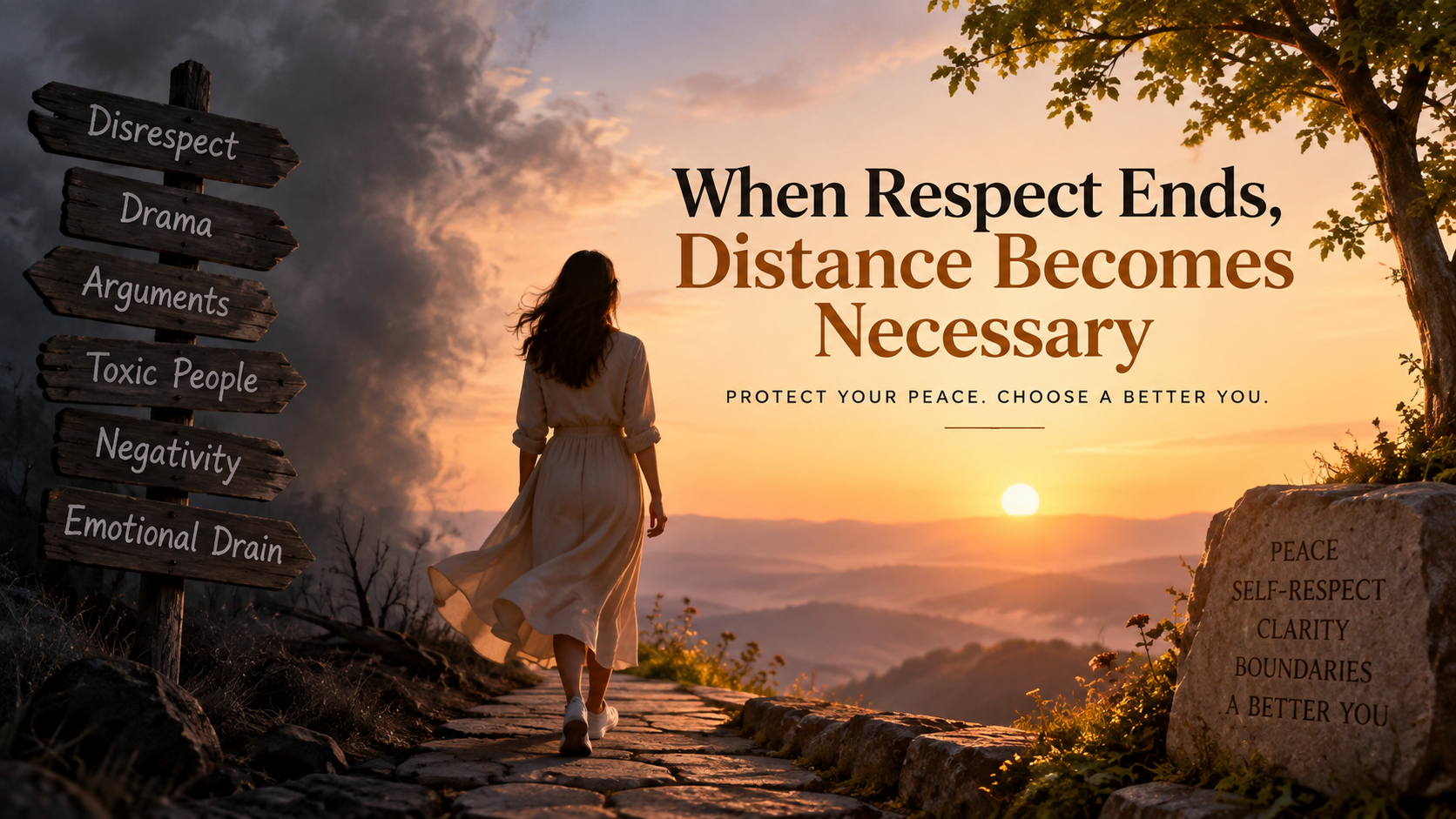
Distance is not always the end of love. Sometimes it is the beginning of self-respect. It is the moment you choose dignity over drama, peace over proving, and clarity over emotional chaos. It is the decision to stop reacting to every provocation and start protecting the person you are becoming.
Disrespect does not always need a loud answer. Sometimes the strongest answer is a calm withdrawal, a closed door, a changed routine, a shorter reply, a cancelled explanation, or a life that continues without giving someone the power to disturb it.
You do not have to argue to prove your worth. You do not have to stay available to prove your kindness. You do not have to keep explaining your pain to people who treat your feelings like an inconvenience.
Sometimes the most powerful thing you can do is step back, breathe, and remove your presence from the place where your respect is not protected.
Because peace is not found in every conversation.
Sometimes, peace begins with distance.