






A practical way to recognise what you can change, accept what you cannot, and stop carrying problems that worry alone will never solve.
It usually begins with something small, an email that has not been answered, a comment from someone whose tone felt different, a pain that was not there last week, a bill arriving at the wrong time, or a meeting invitation with no explanation attached.
The thing itself may take only a few seconds to notice, but the mind can build an entire future around it before the day is over.
By bedtime, the unanswered email has become rejection, the unusual tone has become conflict, the pain has become a serious illness, and the unexpected meeting has become evidence that something is wrong at work.
Nothing new has actually happened, yet the body reacts as though every imagined outcome has already been confirmed.
Most of us have done this more times than we would care to admit, because worry has a convincing way of presenting itself as responsibility. It tells us that we are being sensible, that we are preparing for every possibility, and that if we think hard enough, we might prevent life from surprising us.
In reality, we are often replaying the same fear in slightly different forms while becoming too tired to deal with the situation that is genuinely in front of us.
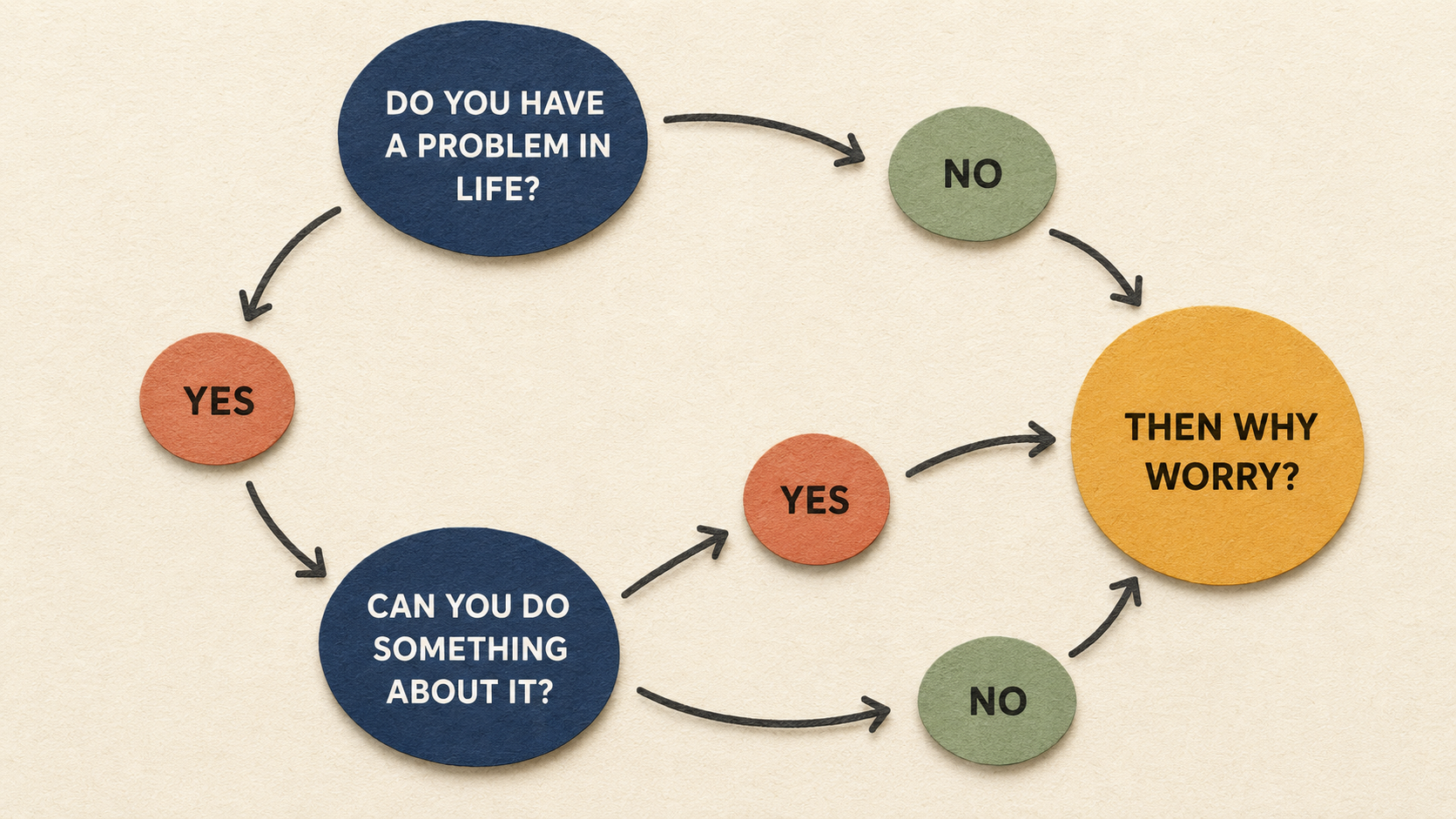
There is no clever technique that removes uncertainty from life, and anyone who promises one is selling something. There is, however, a simple way to interrupt the spiral before it takes over the rest of the day. When a worry appears, ask yourself two questions: Do I actually have a problem right now? If I do, can I do something about it?
The questions are simple, but answering them honestly can change the way we carry difficult situations.
First, Do You Actually Have a Problem Right Now?
This question is not asking whether something unpleasant could happen, because almost anything could happen.
It is asking whether there is a real issue supported by what you currently know, or whether your mind has taken a small amount of information and filled the empty spaces with fear.
Suppose you attend an interview for a role you genuinely want, and the recruiter says you should hear back by Friday.
Friday passes without an update, then the weekend arrives, and by Sunday evening, you have reviewed every answer you gave.
You remember one question you could have handled better, convince yourself that the interviewers noticed your hesitation, and begin wondering whether you are less capable than you thought.
The facts are much shorter than the story: you attended an interview, and the response is late.
The delay might eventually lead to disappointing news, but it could also mean that another interview was rearranged, someone important is on leave, approval is taking longer than expected, or the recruiter simply has not received an answer.
Until more information arrives, rejection is a possibility rather than a fact, and experiencing it repeatedly in advance will not make you better prepared if it eventually happens.
When you notice this happening, try describing the problem in one plain sentence without using words such as “probably,” “always,” “never,” or “what if.”
If you can say, “My payment is overdue,” “My doctor has asked me to return for another test,” or “My manager has raised a concern about my performance,” you have something real to address.
If the sentence is closer to “They have not replied, so they must have rejected me,” then part of what you are carrying belongs to imagination rather than evidence.
That does not mean you should ignore risk or pretend everything will be fine. It simply means that possibility should not be given the same authority as fact.
If the Problem Is Real, Can You Do Something About It?
Once you know that a genuine problem exists, the next question is whether there is any useful action available to you.
This does not mean asking whether you can guarantee the outcome, control everyone involved, or remove every risk, but whether you can take one step that makes the situation clearer, safer, or more manageable.
Many worries become heavier because they arrive in language that no one could act upon. “I need to fix my life” is not a task.
Neither is “I must secure my future,” “I need to stop everything going wrong,” or “I have to make this relationship work.”
These thoughts sound urgent, but they are so large and undefined that they leave us feeling powerless.
A useful action is usually smaller and less dramatic. It might mean sending the follow-up email, booking the appointment, checking the bank statement, asking for an honest conversation, updating the CV, requesting help, or admitting that a decision can no longer be postponed.
The action may not solve everything, but it moves the problem out of your head and into the real world, where new information and choices become possible.
There is an important distinction between doing something useful and doing something merely to feel busy.
A person worried about money can spend an entire evening changing colours and categories in a budgeting spreadsheet while avoiding the overdue letter on the kitchen table.
Someone unhappy at work can watch hours of career advice without applying for a role or speaking to their manager.
Someone worried about a relationship can analyse every message with three different friends while refusing to ask the other person what is actually happening.
Activity is not always action. Sometimes it is worry wearing office clothes.
The most helpful question in those moments is: What is the next honest thing I can do? The word “honest” matters because the right step is often the one we have been avoiding.
It may involve hearing an answer we do not want, accepting responsibility for our part, setting a boundary that could disappoint someone, or beginning again after an earlier attempt did not work.
Control Is Rarely All or Nothing
It helps to separate what you control from what you can influence and what belongs entirely to someone or something else.
You control your effort, conduct, preparation, words, spending choices, and willingness to ask for support.
You may influence a decision, a relationship, or the direction of a project, but other people still have their own needs, opinions, and authority.
Beyond both areas sit events that no amount of thought can rearrange: the past, another person’s private judgement, an organisation’s final decision, and many of the unexpected changes that life delivers without asking permission.
We create additional pain when we confuse these areas, especially when we neglect what is ours because we are preoccupied with what is not. We spend hours trying to predict someone else’s response but delay saying what needs to be said, or we demand certainty about the final outcome before taking the first step that is completely within our control.
Doing your part does not guarantee the result you want, but it gives you something far more useful than endless mental rehearsal: the knowledge that you responded as well as you could with the information you had.
What If There Is Nothing You Can Do?

This is where the advice becomes harder, because taking action often feels more respectable than accepting a limit.
We like the idea that effort can fix anything, yet some situations do not offer us that bargain. A decision may now rest with someone else, an event may already have happened, a relationship may have ended, or a person we love may make a choice we would never make for them.
Acceptance does not mean approving of what happened or pretending that it does not hurt. It means recognising that this is the reality from which life must now continue, whether or not it is the reality we would have chosen.
Grief can exist alongside acceptance, as can anger, disappointment, and regret; what changes is that we stop asking those feelings to rewrite something they have no power to change.
Sometimes nothing can be done forever, while at other times, nothing can be done today.
Waiting for medical results, a legal decision, an interview outcome, or a response after a difficult conversation creates a temporary absence of control.
During that period, checking your phone every four minutes and rehearsing every possible outcome may feel like staying involved, but it does not contribute to the process.
The only useful decision may be how you will look after yourself while you wait. You might decide when you will check for an update, speak to someone who helps you stay grounded, return your attention to ordinary responsibilities, exercise, pray, cook, sleep properly, or choose a date on which you will review the situation.
Giving the worry a review point can be surprisingly helpful because the mind no longer has to keep reminding you that the issue exists.
Acceptance is not passive when it prevents one unresolved matter from consuming every part of your life.
Worry Is Sometimes Trying to Tell You Something
Of course, not every worry should be dismissed as overthinking. If the same concern keeps returning because
someone repeatedly breaks your trust,
because your workplace has become harmful,
because your finances are steadily worsening,
or because your body is showing symptoms that need attention,
then the worry may be pointing towards a truth you have been reluctant to face.
The question is not simply whether you should worry, but what the worry is asking you to notice.
Is it supported by a pattern of evidence, or is it being fed mainly by uncertainty?
Does it point towards a conversation or decision you have avoided, or does it ask you to control another person’s thoughts?
After you take reasonable action, does the concern become more manageable, or does your mind immediately invent another reason to remain afraid?
There are also times when worry grows beyond what a simple change of perspective can manage. If anxiety is affecting your sleep, concentration, appetite, work, relationships, or ability to enjoy everyday life, speaking with a doctor or qualified mental-health professional is an act of responsibility rather than failure.
Advice about letting go should never be used to make people feel guilty for struggling with something that may need proper support.
A More Useful Way to Meet the Next Worry
The aim is not to become a person who never worries, because that would probably require caring about nothing. It is to stop giving worry a job it cannot perform.
When the next concern arrives, pause before allowing it to take control of the whole story. Ask whether you have a real problem or a frightening prediction, then ask whether there is a useful action available.
If there is, take the smallest honest step instead of waiting until you can solve everything at once.
If there is not, acknowledge the limit, decide when the situation genuinely needs your attention again, and return to the life that is still happening around you.
Some problems need courage, some need patience, and some need to be released because carrying them for another week will not change their weight.
Knowing the difference will not remove every difficult moment, but it can save you from experiencing the same difficulty hundreds of times before it has even arrived.