





A reflective journey through stillness, self-doubt, and the courage to change
There are moments in life when nothing dramatic happens on the surface, when no doors slam shut and no voices are raised, when the world continues exactly as it always has, yet something inside us quietly shifts, and we realize that the life we are living no longer fits the person we have become.
This realization rarely arrives with fireworks or warning signs, because most turning points are subtle, unfolding in silence while we are busy fulfilling expectations, meeting deadlines, and convincing ourselves that stability is the same thing as happiness. It often comes during an ordinary moment, while standing at a bus stop after a long day, while washing dishes in a quiet kitchen, or while lying awake at night staring at a ceiling that suddenly feels heavier than usual.
For Aarav, that moment arrived on a late autumn evening when the city was wrapped in a tired grayness, and the streets outside his apartment reflected a familiar routine he had followed for years without question. He had returned from work later than usual, his mind still cluttered with meetings that solved nothing and conversations that went in circles, and as he dropped his keys on the table and loosened his tie, he felt an exhaustion that sleep alone could no longer fix.
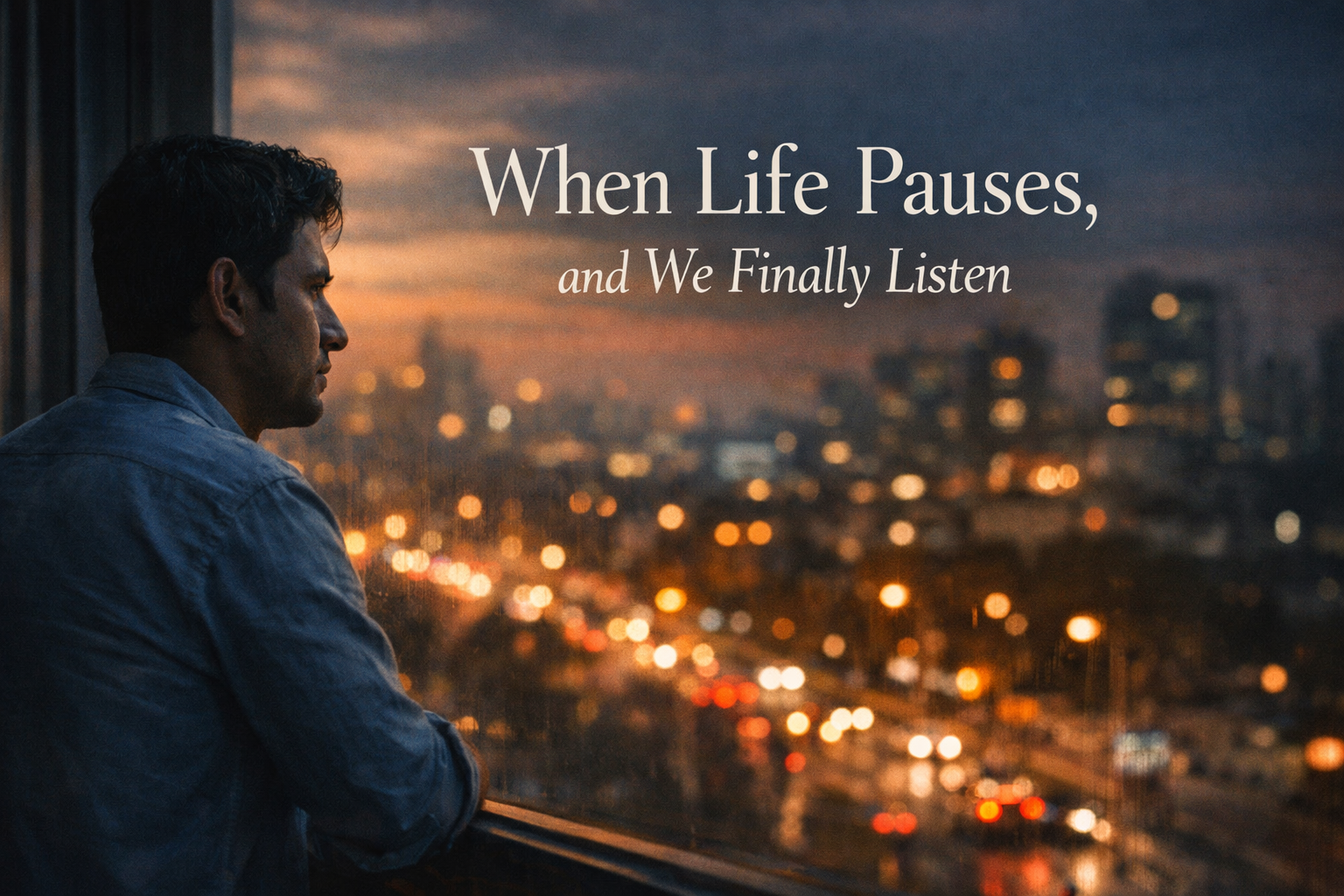
He stood by the window for a long time that night, watching strangers pass below, each one carrying their own invisible stories, and he wondered when he had last felt genuinely present in his own life, when his days had stopped feeling like something to get through and started feeling like something to live.
Aarav had done everything right, at least according to the script he had been handed early in life, because he had studied hard, secured a respectable job, paid his bills on time, and learned how to nod politely in conversations that demanded agreement rather than honesty. His life looked complete from the outside, and if someone had asked him how he was doing, he would have answered with the same practiced response he always gave, which was that he was fine and busy and grateful.
But beneath that surface, something had been quietly eroding, not in a dramatic collapse, but in the slow way water reshapes stone, wearing down joy, curiosity, and the courage to ask difficult questions.
The following morning, Aarav woke before his alarm, his body heavy and his mind restless, and instead of reaching for his phone like he usually did, he sat on the edge of the bed and allowed himself to feel the weight of his own thoughts. He realized that he had been living on autopilot for so long that he no longer remembered what he actually wanted, only what he was supposed to want, and that realization frightened him more than any uncertainty about the future ever could.
He went through the motions of his day with an unfamiliar awareness, noticing the way people spoke without listening, the way time slipped through his fingers, and the way his own reflection in glass windows looked older not because of age, but because of fatigue that came from pretending for too long. By the time evening arrived, he knew that something had to change, even if he did not yet know what that change would look like.
Change, however, rarely announces itself politely, and it often begins with resistance rather than clarity, because letting go of what is familiar feels risky, even when the familiar is quietly draining the life out of us. Aarav spent weeks wrestling with doubts, questioning whether his restlessness was a sign of ingratitude or simply a phase that would pass if he ignored it long enough.
He tried to silence the feeling by working harder, staying later, and filling his weekends with distractions, but the more he avoided the conversation with himself, the louder his unease became. It followed him into meetings, lingered during conversations with friends, and surfaced during moments of silence that could no longer be filled with noise.
One evening, while visiting his childhood home, Aarav found himself sitting across from his father on the balcony where so many conversations had once taken place. The city lights flickered in the distance, and the air carried the comfort of familiarity, and without planning to, Aarav spoke honestly for the first time in years. He spoke about feeling lost despite being successful, about feeling tired despite being young, and about the fear of waking up one day and realizing that he had lived someone else’s life.
His father listened without interruption, his expression calm and thoughtful, and when Aarav finished, he said something that stayed with him long after the conversation ended. He said that a stable life is not the same as a meaningful one, and that safety without purpose eventually feels like a cage, no matter how comfortable it looks from the outside.
Those words did not provide immediate answers, but they opened a door that Aarav could no longer ignore. He began paying attention to what gave him energy instead of what merely paid the bills, and he noticed how alive he felt when he wrote, when he helped others navigate confusion, and when he allowed himself to be curious without worrying about outcomes.
The transition was not dramatic or impulsive, because Aarav did not quit his job overnight or make grand announcements about reinventing himself, but instead, he started small, carving out time for the things that felt real, even when they felt impractical. He wrote in the early mornings before work, volunteered his skills in places that needed guidance rather than perfection, and slowly rebuilt a relationship with himself that had been neglected for years.
There were days when doubt returned, whispering that he was being unrealistic or selfish, and there were moments when the comfort of his old routine tempted him back, but each time he listened closely, he realized that the quiet satisfaction he felt from living more honestly outweighed the temporary comfort of staying the same.
As months passed, Aarav noticed changes that were subtle but profound, because his sleep improved, his conversations deepened, and his sense of time shifted from something that chased him to something he shared with intention. He was not suddenly free of fear or uncertainty, but he had learned how to sit with them without letting them dictate his choices.
The most surprising change was not external but internal, because he began to trust himself again, not because he had all the answers, but because he was finally asking the right questions. He stopped measuring his worth by titles and timelines and started measuring it by alignment, by the quiet sense that his actions matched his values even when no one was watching.
One evening, nearly a year after that first restless night by the window, Aarav stood in the same spot and looked out at the city below. The streets were just as busy, the lights just as bright, and the world just as indifferent, yet something inside him felt lighter, because he knew that he was no longer living on pause.
He understood that life would continue to present challenges, disappointments, and moments of doubt, but he also knew that he had reclaimed the most important thing he had once lost, which was his ability to listen to himself without judgment and to choose courage over convenience.
This is not a story about abandoning responsibility or chasing happiness recklessly, but about the power of awareness, about noticing when a life that looks good on paper no longer feels right in the heart, and about having the patience to change without needing validation or applause.
Because the most meaningful transformations rarely come from dramatic decisions, but from the slow, deliberate choice to live with honesty, even when that honesty asks us to step into uncertainty.
And sometimes, the bravest thing a person can do is not to run away from their life, but to pause long enough to ask whether they are truly present in it, and to listen carefully when the answer finally arrives.
Author’s Note:
This story is a work of fiction, shaped by personal experiences, quiet observations, and emotions many of us carry but rarely speak about. While the characters and events are imagined, the feelings behind them are deeply real.