

Self worth | Personal growth without pressure | Mental clarity
There are sentences we repeat without believing them, sentences we say because they sound right rather than because they feel true, and then there are sentences that take years of lived experience, emotional friction, and internal collapse before they finally land.
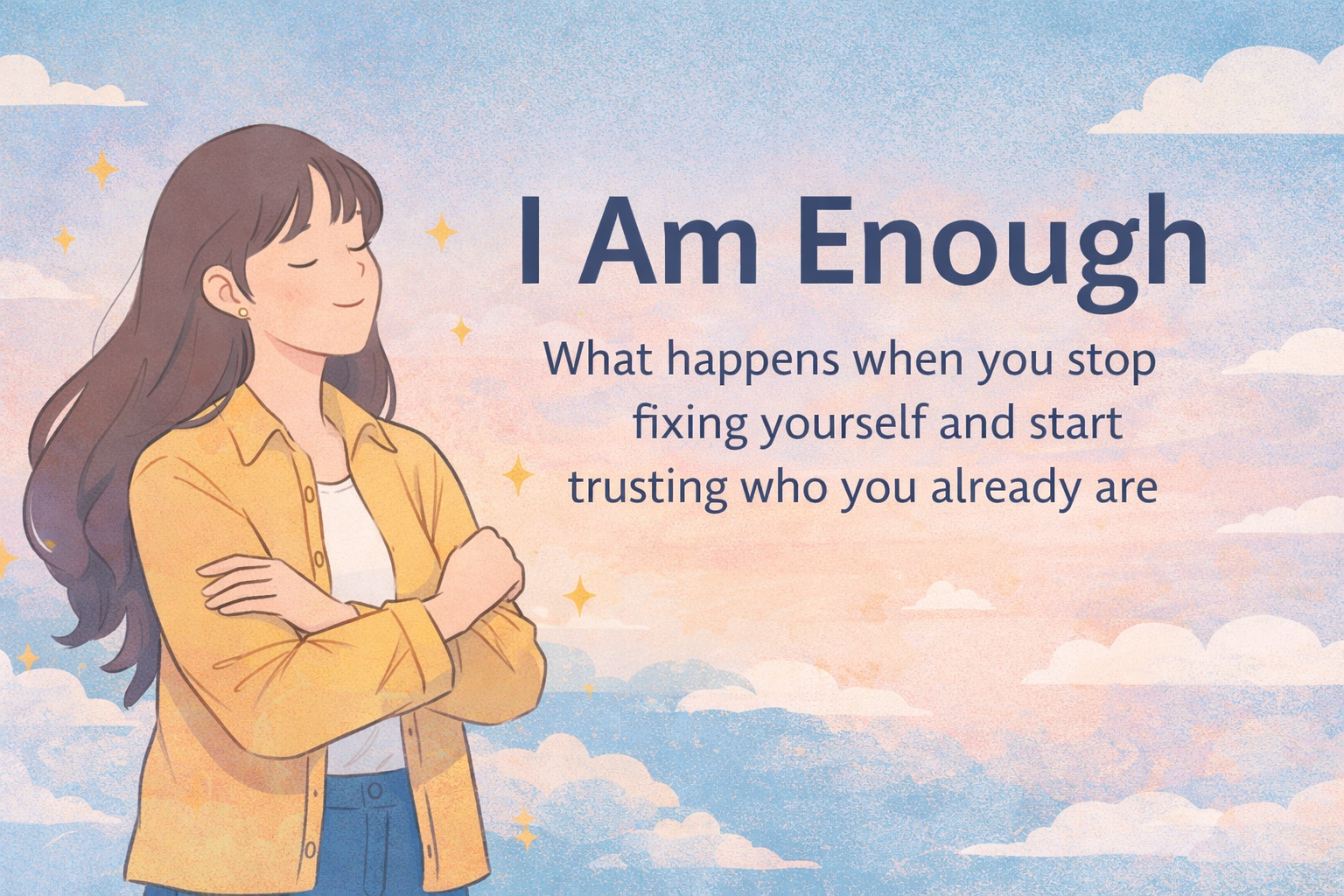
“I am enough” belongs to the last category.
Most people do not reject this sentence because it is false.
They reject it because their lives have trained them to measure worth through performance, approval, productivity, sacrifice, and comparison.
From childhood, we are rewarded for being better, faster, more obedient, more successful, more pleasing, and more resilient, and somewhere along that path, the idea that our value could exist without constant proof begins to feel suspicious.
We grow up believing that being enough is something you earn after you fix yourself.
We wait until we are calmer, more confident, thinner, smarter, richer, healed, promoted, married, disciplined, consistent, or admired, and only then do we feel permitted to rest inside ourselves. Until that day arrives, we live in a state of emotional probation, believing that self acceptance must be postponed.
This belief quietly shapes decisions, relationships, boundaries, careers, and even the way we speak to ourselves when no one is listening.
The Myth of Perfection as a Requirement
One of the earliest lies we absorb is that perfection is the entry ticket to worth.
We see it in schools that celebrate only the top performers, workplaces that reward overextension, families that praise achievement more than effort, and social spaces where vulnerability is often mistaken for weakness.
Perfection becomes the unspoken standard, even though no one ever reaches it.
Instead of motivating us, it creates a permanent sense of insufficiency. No matter how much we improve, there is always another flaw to correct, another gap to close, another version of ourselves we feel pressured to become.
The problem with perfection is not that it is unattainable.
The problem is that it teaches us to delay self respect until a future version of ourselves arrives, and that future version never fully shows up because growth has no finish line.
Being enough does not mean being flawless.
It means recognizing that your imperfections are not evidence of failure but proof that you are human, learning, adapting, and living in the real world rather than in an imagined standard that exists only to keep you chasing.
Weakness Is Not a Disqualification
Many people carry deep shame around their weaknesses, as if struggles are a personal defect rather than a universal condition of being alive.
We hide anxiety behind productivity, uncertainty behind confidence, fear behind overachievement, and exhaustion behind forced positivity.
Weakness becomes something to mask, minimize, or apologize for.
Yet every meaningful transformation in a human life begins at the point where someone stops pretending they are stronger than they are and starts working with the truth of who they are.
Acknowledging weakness does not shrink you.
It grounds you. It allows you to make decisions that are sustainable rather than impressive, and it opens the door to growth that is rooted in self awareness instead of self punishment.
Being enough includes your limits.
It includes the days you do not perform at your best, the moments you hesitate, the skills you have not mastered yet, and the emotions you do not always manage gracefully.
Strength is not the absence of weakness.
Strength is the willingness to live honestly with it.
You Were Never Meant to Know Everything
There is a quiet pressure in modern life to have answers, opinions, plans, and clarity at all times.
Not knowing is treated as incompetence rather than as a natural phase of learning.
This creates a deep internal tension, especially for people who tie their identity to competence and reliability. They feel unsafe admitting uncertainty, even to themselves, because they fear it will unravel the image they have built.
But growth does not happen in certainty.
Growth happens in curiosity, exploration, mistakes, revisions, and moments where you admit that you are figuring things out as you go.
Being enough does not require omniscience.
It allows space for questions, confusion, and change of mind. It accepts that some seasons of life are meant for exploration rather than execution.
When you stop demanding that you must always know what comes next, you begin to trust your ability to respond rather than control. That shift alone can bring a sense of relief that no achievement ever provides.
Doing What Is Best for You Is Not Selfish
Many people confuse self respect with selfishness because they were raised to prioritize harmony over honesty.
They learned early that saying yes made them lovable and that saying no created discomfort, conflict, or distance.
Over time, they began to override their own needs in order to maintain approval.
They became experts at sensing what others wanted while losing touch with what they themselves needed.
Living this way creates a slow erosion of identity.
You show up everywhere but never fully arrive anywhere, including in your own life.
Doing what is best for you is not an act of rejection toward others.
It is an act of alignment with yourself. It allows you to show up from a place of authenticity rather than resentment.
When you respect your own limits, values, and priorities, your relationships become clearer, your energy becomes more stable, and your decisions feel grounded instead of reactive.
Being enough means trusting your inner compass even when it points in a direction that others do not immediately understand.
You Cannot Please Everyone and You Were Never Supposed To
One of the most liberating truths a person can accept is that universal approval is impossible.
No matter how kind, competent, or considerate you are, someone will misunderstand you, disagree with you, or disapprove of your choices.
Trying to manage everyone’s perception of you is an exhausting full time job with no successful outcome.
It keeps you hyper vigilant, emotionally drained, and disconnected from your own truth.
When you stop trying to please everyone, something surprising happens.
The people who truly align with you feel closer, the relationships that depend on self abandonment naturally fall away, and your sense of self becomes less fragile.
Being enough does not require being liked by everyone.
It requires being honest with yourself and respectful toward others, even when that honesty creates distance.
Freedom often begins where people pleasing ends.
Learning to Say No Without Guilt
Saying no is one of the most emotionally complex skills to develop, especially for people who associate worth with usefulness.
They feel anxious declining requests, setting boundaries, or prioritizing rest because they fear disappointing others.
But every yes that is spoken at the expense of your well being becomes a debt you eventually have to pay.
It shows up as burnout, resentment, emotional numbness, or sudden withdrawal.
Saying no is not an act of aggression.
It is an act of self preservation. It communicates clarity, not rejection.
When you learn to say no without over explaining, apologizing excessively, or justifying your existence, you reinforce the belief that your needs matter too.
Being enough includes having the right to protect your time, energy, and emotional capacity.
Growth Is Not a Linear Process
We often imagine growth as a straight upward line where each year is better than the last and every lesson leads to visible progress.
Real growth rarely looks like that.
It looks like cycles of confidence and doubt, clarity and confusion, momentum and pause.
It includes setbacks that feel like failure until hindsight reveals their purpose.
If you only feel worthy when you are improving, you will struggle during the seasons when growth is internal rather than visible.
Those seasons are not wasted. They are often where the deepest shifts occur.
Being enough while still growing means honoring who you are today without dismissing who you are becoming.
It allows you to move forward without carrying shame about where you started.
Mistakes Do Not Cancel Your Worth
Mistakes are often treated as moral failures rather than as information.
People internalize errors as proof that they are flawed rather than as feedback that guides future choices.
This mindset creates fear around risk and experimentation.
It keeps people stuck in familiar patterns even when those patterns no longer serve them.
Every skill you possess today was once something you were bad at.
Every boundary you hold was once something you struggled to enforce. Every insight you carry came from an experience that did not go as planned.
Being enough includes making mistakes and learning from them without defining yourself by them.
Your worth is not reduced by missteps.
It is revealed by how you respond to them.
It Is Safe to Be Unapologetically Yourself
Many people live with a subtle fear that if they fully express who they are, they will lose connection, security, or belonging.
So they edit themselves. They soften their opinions, hide their needs, and shape shift to fit different environments.
Over time, this creates an internal split where the public self and the private self drift further apart.
The result is loneliness even in the presence of others.
Being unapologetically yourself does not mean being insensitive or rigid.
It means showing up with honesty, integrity, and self respect.
When you stop apologizing for existing, taking up space, or having needs, you give others permission to do the same.
Authenticity has a ripple effect.
Being enough is not about proving anything.
It is about coming home to yourself without conditions.
The Truth About Self Acceptance
Self acceptance is not a destination you reach after healing everything.
It is a practice you return to, especially on days when doubt resurfaces.
It means choosing self respect even when you feel uncertain.
It means speaking to yourself with the same fairness you offer others.
“I am enough” is not a statement of completion.
It is a statement of worth that exists alongside growth, effort, and change.
You do not need to earn the right to belong to your own life.
You are already here. You are already trying. You are already learning.
That is enough.