



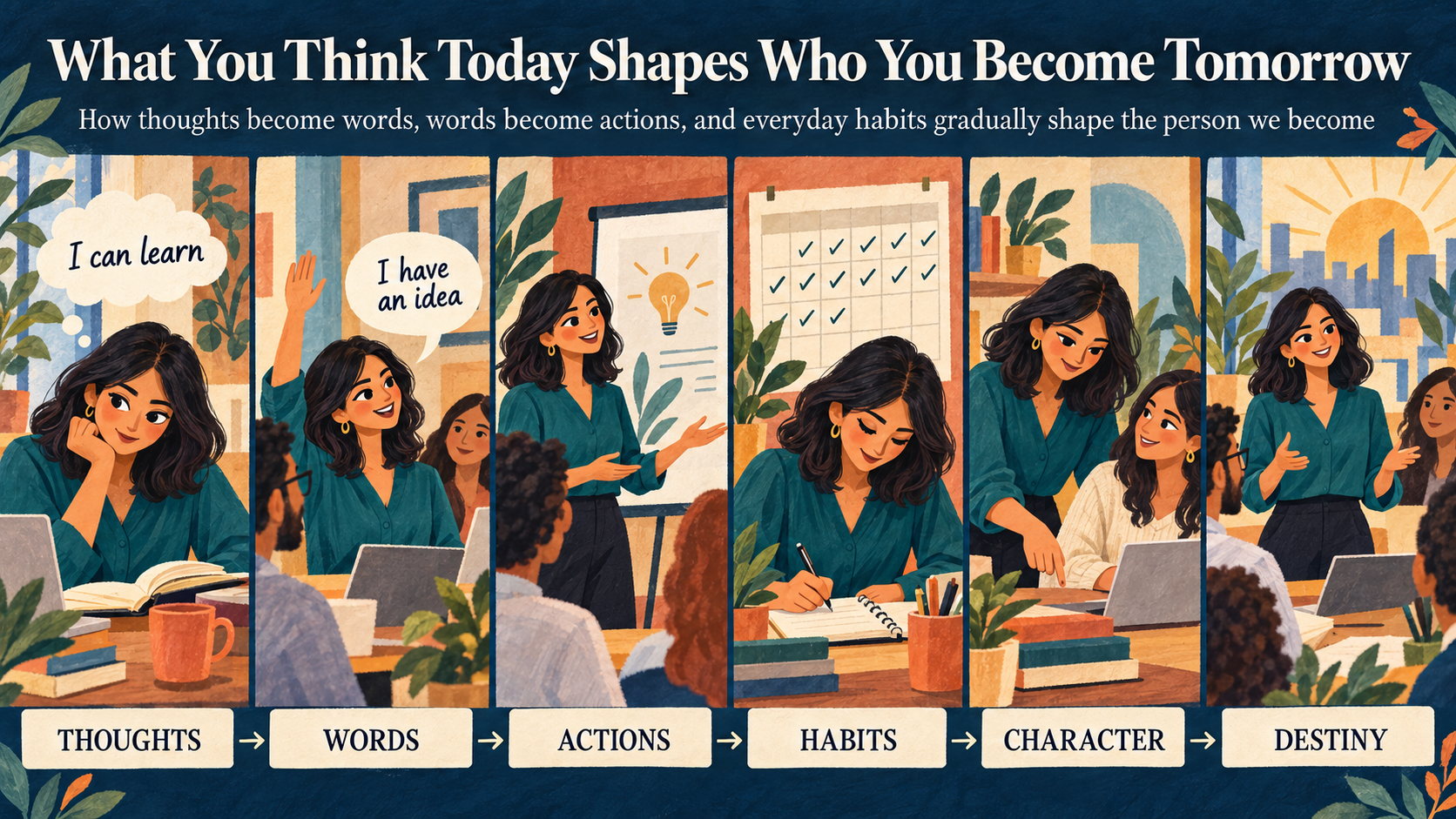
How thoughts become words, words become actions, and everyday habits gradually shape the person we become
Every life is shaped twice: first within the mind, where nobody else can see it, and then in the world, where its consequences become visible.
A thought may appear too small to matter when it first arrives. It leaves no footprint, makes no sound, and asks for no immediate commitment, yet when the same thought is welcomed repeatedly, it begins to influence the language we use, the choices we make, and the person we gradually become.
Long before destiny looks like destiny, it often exists as an ordinary idea that has been given permission to remain.
Anaya did not understand this when she first began working at a publishing company in the city. She was intelligent, capable, and genuinely interested in her work, but she carried a private belief that followed her into every meeting: she did not think she was as talented as the people around her.
Nobody had told her this directly. Her manager trusted her, her colleagues appreciated her judgement, and her clients regularly praised her work, yet none of that evidence seemed strong enough to silence the story she had created about herself.
Whenever an opportunity appeared, the same thoughts returned.
Someone else would do this better.
I am not ready yet.
If I speak and get something wrong, everyone will realise that I do not belong here.
At first, those thoughts stayed inside her mind, where they appeared harmless. Over time, however, they began slipping into her conversations.
“I am probably wrong, but…”
“This may be a silly suggestion…”
“I do not have as much experience as everyone else…”
She used these phrases so often that she no longer noticed them. They had become a verbal habit, an automatic introduction to almost every idea she shared. Even when her suggestion was excellent, she presented it as though she were apologising for taking up space.
Her colleagues gradually responded to the uncertainty in her language. Some interrupted her because she seemed unsure of her own point. Others repeated her ideas with greater confidence and received credit for them.
Her manager continued to encourage her, but when an important client presentation became available, he selected someone who appeared more comfortable speaking under pressure.
Anaya felt overlooked, although a significant part of the problem had begun much earlier, within thoughts that nobody else could see.
A Thought Is Small, but It Is Never Powerless
The mind produces countless thoughts throughout the day, and not every thought deserves to be believed. Some arise from experience, some from fear, some from exhaustion, and others from assumptions that have never been properly examined.
The danger begins when we confuse repetition with truth.
If a person repeatedly thinks, People cannot be trusted, that belief eventually enters their conversations. Their words become guarded, suspicious, or defensive, even when the situation does not justify such a response.
Those words then influence their actions, perhaps causing them to withdraw, test other people unnecessarily, or reject support.
Repeated often enough, those actions become habits, and the habits eventually create a character that finds closeness difficult.
The original thought may have occupied only a few seconds, but its influence can stretch across years.
The same process can work in a healthier direction. A person who begins thinking, I can learn what I do not yet know, approaches uncertainty differently from someone who believes every gap in knowledge is proof of inadequacy.
The first person asks questions, practises, accepts correction, and gradually improves. Learning becomes a habit, curiosity becomes part of their character, and possibilities appear that would otherwise have remained closed.
Thoughts do not predict the future like fortune-tellers. They help construct it by influencing what we repeatedly say and do.
The Conversation That Changed Her Direction
Several months after the client presentation, Anaya visited her grandmother, who lived in the same small town where Anaya had spent much of her childhood. During dinner, her grandmother asked about work, and Anaya explained how capable people kept moving ahead while she seemed to remain in the same place.
Her grandmother listened carefully before asking, “When did you decide that they were more capable than you?”
Anaya immediately began listing their qualifications, confidence, and years of experience, but her grandmother interrupted with another question.
“That was not what I asked. I asked when you decided it.”
The question unsettled her because she could not identify a particular moment. There had been no formal announcement, no dramatic failure, and no undeniable proof. The belief had grown from comparisons, forgotten criticisms, difficult experiences, and years of noticing other people’s strengths while examining her own weaknesses under a magnifying glass.
Her grandmother reached for an old ceramic bowl on the dining table. It was filled with small seeds intended for the garden.
“Every one of these seeds looks insignificant,” she said, “but once planted and watered, each one begins becoming something. Your mind works in much the same way, except you keep watering ideas that you would never deliberately plant.”
Anaya smiled at the simplicity of the comparison, although its meaning remained with her long after dinner had ended.
She could not control every thought that entered her mind, but she could decide which ones received attention, repetition, and authority.
Words Give Thoughts a Place in the World
A thought remains private until language gives it a public form. Once spoken, it can encourage someone, wound them, influence a decision, repair a relationship, or damage trust that took years to establish.
This is why words deserve more care than we often give them.
People sometimes defend hurtful speech by saying, “I was only being honest,” as though honesty and cruelty were inseparable companions. The truth can usually be expressed without humiliation, and frustration can be communicated without turning another person into an enemy. The words we choose reveal not only what happened around us, but also what has been growing within us.
Repeated criticism trains the mind to keep searching for faults. Repeated gossip makes disrespect feel socially acceptable. Repeated complaints teach us to notice inconvenience before opportunity. In the same way, language shaped by gratitude, responsibility, and possibility encourages the mind to recognise more of those qualities.
This does not mean pretending that everything is wonderful when it clearly is not. Mature thinking does not deny disappointment, injustice, grief, or anger. It allows us to acknowledge reality without letting every painful moment dictate the language through which we understand our entire life.
After returning to the city, Anaya began paying closer attention to the way she spoke. She noticed how often she reduced the value of her own contributions before anyone else had the opportunity to consider them.
She decided to make one small change. Instead of saying, “This is probably a bad idea,” she would say, “I have a suggestion that may help us approach this differently.”
The change felt uncomfortable because confidence had not yet become natural to her. Still, she continued, and those revised words gradually changed how she behaved in meetings.
Actions Are Thoughts Made Visible
Positive language alone cannot transform a life if it never develops into action. We can speak beautifully about discipline, kindness, courage, and ambition, but our repeated behaviour eventually reveals which values are real and which ones merely sound attractive.
Anaya began preparing one useful contribution before every meeting. She wrote down her reasoning, considered possible objections, and committed herself to speaking before the conversation ended. Some of her ideas were accepted, while others were challenged or rejected, yet she discovered that disagreement was not the catastrophe she had expected.
More importantly, she started gathering evidence against the belief that she was incapable.
Each time she spoke, she made the next attempt slightly easier. Each time she survived criticism, fear lost some of its authority. Each time she prepared carefully, competence became less dependent on mood and more connected to practice.
Actions have this practical power because they allow us to experience a different version of ourselves. A person may think about becoming healthier for years, but the identity begins changing when they repeatedly choose nourishing food, exercise despite limited motivation, and honour the promises made to their own body. Someone may want to become dependable, but dependability is created when they arrive on time, complete commitments, admit mistakes, and remain present when circumstances become inconvenient.
We become participants in our development when intention moves beyond thought and enters behaviour.
Habits Build What Motivation Cannot Sustain
Individual actions matter, but repetition gives them strength. One generous act does not automatically create a generous person, just as one selfish decision does not define an entire character. The pattern matters more than the isolated moment.
Motivation is often treated as the great engine of personal change, although it is unreliable and highly influenced by mood, energy, and circumstance. Habits are less glamorous, but they continue working after excitement has disappeared.
A writer becomes a writer by returning to the page. A leader becomes trustworthy by behaving consistently when decisions are difficult. A relationship becomes strong through repeated attention, honesty, patience, and repair. A career grows through ordinary days of learning, preparation, collaboration, and responsible delivery.
Anaya’s new behaviour eventually became routine. She no longer needed to negotiate with herself before every meeting because preparation and participation had become part of how she worked. She volunteered for a complicated assignment, led discussions with the client, and openly acknowledged the subjects she still needed to learn without treating them as evidence of personal failure.
The work did not suddenly become easy, nor did insecurity disappear completely. The difference was that insecurity no longer made every decision on her behalf.
Character Is Formed When Nobody Is Applauding
Character is sometimes discussed as though it were a quality people either possess or lack, but much of it is built through accumulated choices. Honesty grows when we tell the truth even when deception would be more convenient. Patience develops when we practise restraint during repeated frustration. Courage grows when we act responsibly despite fear, not when fear is permanently absent.
Public moments may reveal character, but ordinary private decisions usually create it.
The employee who takes responsibility for a mistake rather than hiding it is shaping character. The friend who refuses to share a private confidence for social attention is shaping character. The person who continues treating service workers with respect when nobody important is watching is shaping character.
These moments rarely feel connected to destiny because they are too common to appear significant. However, opportunities, relationships, and reputations are frequently built upon precisely these patterns.
When people describe someone as reliable, compassionate, disciplined, or courageous, they are usually summarising hundreds of small actions that occurred over time. Character is the name we give to behaviour after it has become consistent enough to be trusted.
Destiny Often Arrives Disguised as Consequence
Two years after that conversation with her grandmother, Anaya was asked to lead the company’s largest publishing programme. Her manager explained that the decision had been based not only on her knowledge, but also on the way she communicated, handled disagreement, supported colleagues, and took responsibility during difficult periods.
To everyone else, the promotion seemed like a major turning point. To Anaya, it felt more like the visible result of changes that had started long before the announcement.
The opportunity had not been created by one impressive presentation or a fortunate conversation with senior leadership. It had grown from the thoughts she challenged, the language she changed, the actions she repeated, and the habits she practised until they became part of her character.
Destiny is often misunderstood as a fixed destination waiting somewhere in the future. Although circumstances, luck, privilege, loss, and other people’s decisions undeniably influence our lives, we are not entirely powerless passengers. Our character affects how we respond to opportunities, setbacks, responsibility, and uncertainty, and those responses frequently shape where life leads next.
A resentful character can turn even a promising opportunity into another source of conflict. A disciplined character can use a modest opportunity as the beginning of something greater. A dishonest character may achieve success temporarily but struggle to preserve trust. A compassionate character can create meaning even in circumstances that were never chosen.
We cannot control every event, but we continually participate in deciding who will meet those events when they arrive.
Guarding the Beginning of the Chain
Watching our thoughts does not mean policing the mind with fear or feeling guilty whenever something negative appears. Human beings experience anger, jealousy, anxiety, doubt, and resentment, and pretending otherwise only drives those emotions into places where they become harder to understand.
The wiser response is to examine them before they become instructions.
When a thought appears repeatedly, we can ask whether it is supported by evidence, whether it reflects the whole situation, and whether following it will move us toward the person we want to become. We can notice the difference between I failed at this task and I am a failure, because one describes an event while the other turns disappointment into identity.
We can also pause before speaking, especially when emotions are intense. A few seconds of consideration may prevent a sentence from creating damage that requires months to repair. If words have already caused harm, character is demonstrated through a sincere apology, changed behaviour, and a willingness to rebuild trust without demanding immediate forgiveness.
Most importantly, we can choose small actions that support better thoughts. When the mind says change is impossible, one constructive action offers evidence that movement has already begun. When the mind insists that nobody cares, reaching out creates an opportunity for connection. When fear says we are permanently unprepared, careful practice gives confidence something solid upon which to stand.
The Future Begins Much Earlier Than We Think
We often look for the turning point that will change everything: the ideal job, the perfect relationship, the financial breakthrough, the right opportunity, or the day when motivation finally becomes permanent. Meanwhile, the real turning points may already be occurring in unnoticed moments.
They appear when we choose which thoughts to entertain, which words to repeat, and which actions to practise. They continue when those actions become habits and those habits become a character that influences every important decision we make.
A fulfilling life is rarely built by one grand choice. It is constructed through thousands of smaller choices that begin to resemble one another.
The thought becomes a sentence. The sentence becomes a decision. The decision becomes a pattern. The pattern becomes a way of living, and that way of living carries us toward a future that once appeared to be shaped by chance alone.
So pay attention to what you repeatedly tell yourself, especially when nobody else can hear it. Those private sentences may become tomorrow’s conversations, choices, relationships, and opportunities.
Destiny may look distant, but its earliest foundations are often being laid within the mind today.