





There is something unsettling about how people react when someone close to them begins to grow, change, or rise beyond what feels familiar. It is not always loud hostility or open jealousy, but rather a subtle, almost invisible resistance that shows up in jokes, comparisons, doubts, and passive discouragement. This pattern is so common that it has earned a name across cultures, the crab mentality, a psychological and social behavior where individuals prevent others from succeeding because they themselves feel unable, insecure, or threatened by that success.
At first glance, it seems irrational. Why would someone stop another person from climbing higher when it does not cost them anything to simply watch, support, or step aside? Yet human emotions are rarely logical, and the roots of this behavior run far deeper than simple envy. They stretch into childhood conditioning, societal pressure, personal insecurity, and an unspoken belief that success is a limited resource that must be competed for rather than shared.
Crab mentality does not only exist in toxic workplaces or competitive environments. It appears in families, friendships, classrooms, communities, and even within our own inner thoughts. Understanding it requires patience, honesty, and the willingness to look at uncomfortable truths about how people, including ourselves, sometimes behave when faced with another person’s progress.
Why one crab can escape but two will not
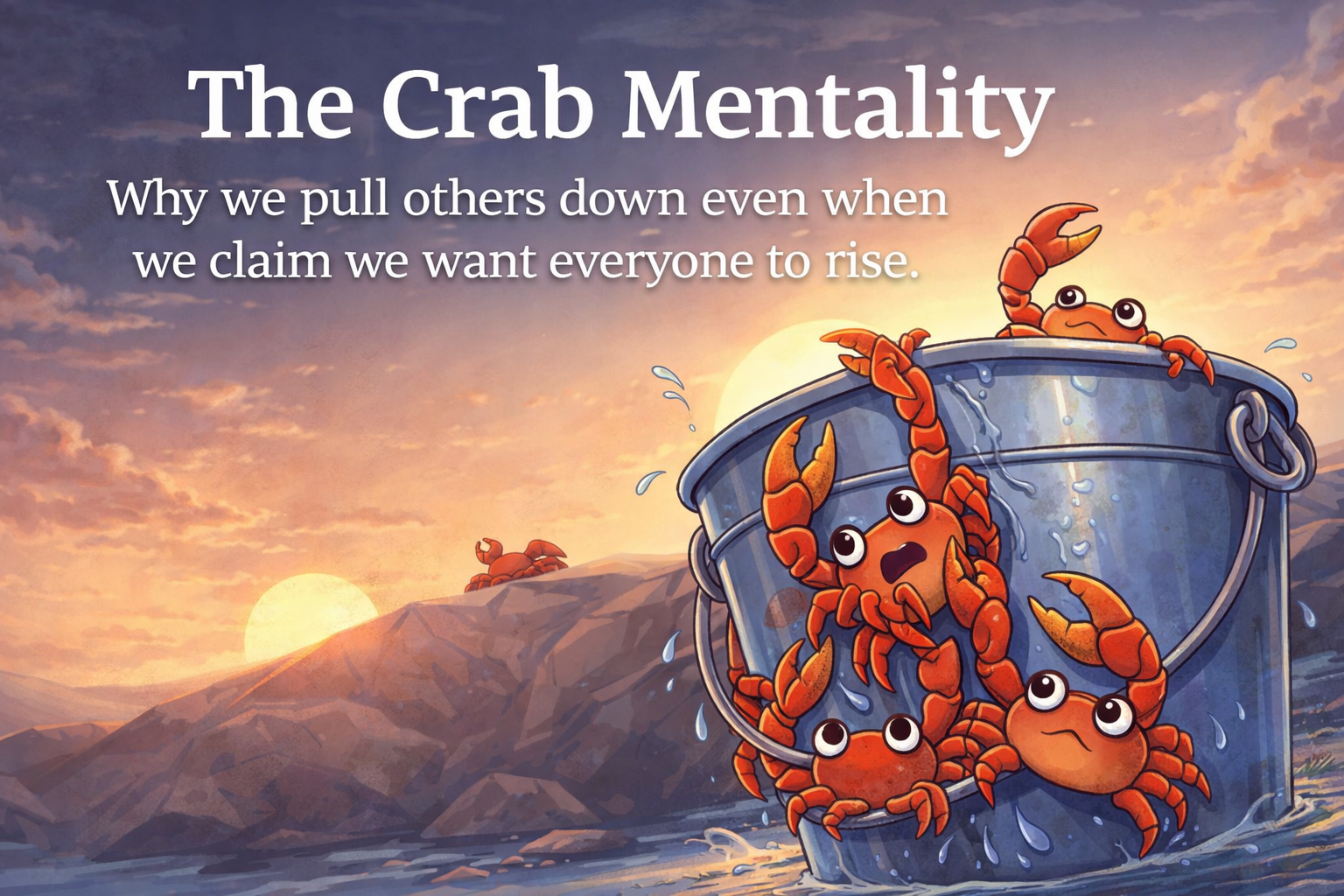
If a single crab is placed in a bucket, it will eventually find a way to climb out, testing the edges, using its strength, and refusing to remain confined. The moment another crab is placed inside the same bucket, something changes. Instead of working together or minding their own struggle, one crab begins to pull the other down whenever it gets close to freedom.
This is not malicious in the way humans understand cruelty, but rather instinctive behavior driven by fear, competition, and a distorted sense of balance. The second crab does not want to be left behind, so it drags the first back into confinement, creating a situation where both remain trapped rather than one escaping.
Human behavior mirrors this dynamic far more often than people care to admit. When someone in a group starts improving their life, building a business, pursuing education, changing habits, or stepping into leadership, others may feel unsettled rather than inspired. Instead of saying, if they can do it, maybe I can too, the reaction becomes, if they move ahead, what does that say about me.
This mindset turns growth into a threat rather than an opportunity. It transforms success into a reminder of personal stagnation. It creates an environment where lifting others feels uncomfortable because it highlights one’s own limitations.
It is not really about hatred
Crab mentality is often misunderstood as pure jealousy or bitterness, but its emotional foundation is more complex than that. At its core, it is rooted in fear rather than hate. Fear of being left behind. Fear of becoming irrelevant. Fear of facing one’s own lack of effort, discipline, or courage.
When someone grows beyond their current circle, the people around them may feel subconsciously judged, even if no judgment is intended. They may interpret that person’s progress as proof that they should have done more with their own life. Instead of confronting that feeling, they project discomfort outward, discouraging the very person who is trying to evolve.
This is why crab mentality often appears in subtle ways rather than direct attacks. People might mock ambition, question motives, minimize achievements, or plant seeds of doubt. They might say things like, do not get ahead of yourself, you are changing too much, or you think you are better than us now. None of these statements sound openly aggressive, yet they slowly chip away at confidence and motivation.
It is easier to pull someone down than to examine one’s own fears. It is simpler to maintain the comfort of sameness than to challenge personal limitations. In this way, crab mentality becomes a defense mechanism disguised as concern or realism.
The invisible bucket we all live in
Most people do not walk around thinking they are trapped in a metaphorical bucket, yet social conditioning creates exactly that kind of limitation. From a young age, individuals are shaped by expectations, comparisons, and norms that define what is acceptable, achievable, or realistic.
Families may unintentionally discourage risk because they equate safety with stability. Schools may reward conformity more than creativity. Workplaces may value obedience over initiative. Communities may celebrate sameness rather than individuality. Over time, these influences create an invisible boundary around personal ambition.
When someone steps outside that boundary, they disrupt the unspoken agreement that everyone should remain within the same comfort zone. This disruption triggers resistance, not because the person is doing anything wrong, but because their actions challenge the collective sense of normalcy.
People often mistake this reaction for genuine concern. They frame their discouragement as protection, saying they are just being practical or realistic. In reality, they are reacting to the discomfort of seeing someone break free from shared limitations.
How crab mentality shows up in real life
In professional environments, crab mentality can be seen when a colleague gets promoted and instead of receiving support, they face gossip, resentment, or passive resistance. Others may downplay their achievements or attribute their success to luck rather than effort.
In friendships, it appears when one person starts improving their health, finances, or mindset, and suddenly receives teasing remarks about being too serious or too different. The group may subtly pressure them to revert to old habits instead of encouraging positive change.
In families, it can manifest as resistance to unconventional career choices or personal transformation. A person who decides to leave a secure job to pursue a passion may be met with skepticism rather than belief. Their dreams are questioned not because they lack potential, but because they challenge traditional expectations.
Even within oneself, crab mentality can surface in the form of self-doubt and self-sabotage. The inner voice that says you are not ready, you do not deserve this, or people will judge you acts like an internal crab pulling the mind back into familiar limitations.
Why pulling others down never truly helps
There is a tragic irony in crab mentality. The act of dragging someone down does not elevate the person doing the pulling. It does not create success, security, or fulfillment. Instead, it keeps everyone trapped in the same confined space, repeating the same patterns of frustration and stagnation.
People who engage in this behavior may feel a temporary sense of control or superiority, but it does not last. Deep down, they remain aware that they have not moved forward. Their energy is spent preventing others from rising rather than building their own path upward.
True growth does not require the failure of others. Real confidence does not depend on diminishing someone else’s light. A strong person does not feel threatened by another’s progress, because they understand that success is not a zero-sum game.
Breaking out of the bucket
Escaping crab mentality begins with awareness. Recognizing when fear, comparison, or insecurity is driving behavior makes it possible to choose a different response. Instead of reacting instinctively, a person can pause and reflect on what truly motivates their feelings.
Supporting others does not mean ignoring personal struggles. It means acknowledging that someone else’s success does not take anything away from one’s own potential. It requires shifting from scarcity thinking to abundance thinking, believing that there is room for multiple people to rise at the same time.
Building this mindset involves surrounding oneself with people who celebrate growth rather than resist it. It means stepping away from environments that thrive on competition and negativity. It also requires cultivating self-worth so that another person’s progress does not feel like a personal threat.
On an internal level, breaking free means challenging limiting beliefs and replacing self-doubt with self-trust. It involves recognizing that the only real bucket is the one created by fear, conditioning, and comparison.
Becoming the crab that climbs
Choosing to be the crab that climbs rather than the one that pulls requires courage, patience, and emotional maturity. It means accepting that growth may make some people uncomfortable, yet moving forward anyway.
It involves celebrating others without feeling diminished. It requires offering encouragement instead of criticism. It means refusing to participate in gossip, resentment, or subtle sabotage.
Most importantly, it means redefining success not as something taken from others, but as something built through effort, learning, and resilience. When this shift happens, the entire dynamic changes. Instead of dragging each other down, people begin to inspire, uplift, and motivate one another.
The choice that shapes everything
Crab mentality is not an inevitable human flaw, but rather a pattern that can be unlearned. Every individual faces moments where they must choose between pulling someone down or allowing them to rise. That choice, repeated over time, shapes relationships, careers, and personal growth.
Those who choose support over fear build stronger connections and healthier environments. Those who choose to rise alongside others rather than compete against them create spaces where success becomes shared rather than isolated.
The real tragedy is not that some people pull others down, but that so many do it without realizing how much they are limiting themselves in the process. The real victory is not escaping the bucket alone, but creating a world where more people are willing to climb together.
A final reflection
Crab mentality reveals uncomfortable truths about human nature, yet it also offers an opportunity for transformation. It reminds people that growth is often resisted, that insecurity masquerades as realism, and that fear can quietly shape behavior.
At the same time, it highlights a powerful possibility. If people can learn to let others climb, to support rather than sabotage, and to see success as something expansive rather than restrictive, then the metaphorical bucket begins to lose its grip.
Pulling someone down will never lift anyone up. Letting them rise does not leave anyone behind. It simply opens the path for more people to discover their own strength, their own ambition, and their own way out of the bucket.